
Can You Have Mold Without a Leak? Yes, If Humidity Stays High
Quick Answer
Mold can grow without a leak when indoor humidity stays high. Tight Texas homes, an oversized air conditioner, and a shower fan left off are often why.
Can you have mold without a leak? Yes. Mold can grow without any leak at all if indoor humidity stays high, because damp air alone can feed it. You can walk every ceiling, every sink, and every window, find no drip and no stain, and the air can still be wet enough to feed mold. In a tight Texas home, an air conditioner that cools fast and shuts off, no dehumidifier, and a bathroom fan left off during the shower are often the whole reason.
Why doesn't "there is no leak" mean there is no mold?
It feels like a closed case, and it is not one. A leak is one way water gets into a building. It is not the only way. If you stop looking the moment nobody can point at a pipe, you can live for a long time in air that is wet enough for mold and never see a stain that would prove you right.
I know what a reasonable sentence can do to a family, because one of those sentences kept us in the house for years. If you have read why mold does not make everyone in the house sick the same way, you already know which sentence I mean. Wouldn't we all be sick, then? It sounded calm. It sounded like common sense. And it won, over and over, until I could finally answer it.
There is a newer version of that sentence, and I hear it just as often. There is no leak. The ceilings are clean. The plumber already came. So it cannot be the house. Fine and dry are not the same thing. I am not interested in scaring you into tearing out a wall because a room feels a little sticky. I am interested in the people who were told the house was fine because nobody could point at a drip.
Can humidity cause mold in a house without a leak?
Yes. Mold cannot grow without moisture, but it does not need a puddle you can photograph. Humid air counts.
The U.S. Environmental Protection Agency puts it in one line I come back to a lot. The key to mold control is moisture control. Moisture is water, whether it is running down a wall or hanging in the air as humidity. On the EPA's mold and health page, the point is just as plain. Mold spores are usually not a problem indoors unless they land on a wet or damp spot and start growing. Grout, a drywall edge, the back of a vanity, the paper face of a wall behind a cold vent. Those surfaces do not have to be dripping to be damp enough. That is how humid air grows mold on bathroom grout and walls with no leak anywhere.
The Institute of Medicine said the same thing from the building side. Molds and other microbial agents favor damp indoor environments. Damp does not mean a flood you can film. It means the building stayed wet long enough for growth to get comfortable. The World Health Organization's review of dampness and mould is useful here if you have been told this is only a housekeeping quibble. The most important way to avoid the health effects is to prevent persistent dampness and microbial growth on indoor surfaces and in the structure of the building. The moisture is the problem. A missing stain does not cancel that.
This is also why a house can look handled after a cleanup and still grow mold again. I wrote about that in can mold come back after remediation. Sometimes the crew pulled the rotten board, and the water that was left behind was not a leak at all. It was humidity that sat too high all summer. Cleanup does not fix that. The air is still doing the same thing it did before they arrived.
If you have ever caught a musty smell and then talked yourself out of it because you could not find the source, read what mold smells like. Odor is information. A clean ceiling is not a clean bill of health.
The EPA also says to dry wet materials within 24 to 48 hours, because that is about how long mold needs to get started. A slow drip hits that window every day it goes unnoticed. So does air that keeps a surface damp without ever making a puddle. You do not need a dramatic flood for the clock to matter. You need the material to stay wet, and humid air is very good at that.
Why do tight Texas homes hold so much humidity?
A lot of newer homes here are built to keep the heat out, and on a Texas power bill that is a kindness. Thick insulation. Sealed windows. Fewer gaps for outdoor air to wander through. The house is proud of how little it leaks to the outside.
That same pride is how the air gets stuck.
An older, draftier house had a rude way of drying itself. Air moved. Moisture left, even when you did not ask it to. A tight, energy-efficient house does not do you that favor. Showers, cooking, breathing, a dishwasher, a family home all afternoon. Every one of those adds water to air that has a harder time leaving. The walls can look perfect. The air can still be wet.
Over-insulated, in this conversation, does not mean insulation is bad. It means the building was closed up tight and nobody gave the moisture a way out. No breathability is not a slogan. It is a house that holds what you put into it, including water you cannot see. People hear "energy-efficient" and picture a healthier house. Sometimes that is true. Sometimes it only means the outdoor heat stays out, and the indoor moisture stays in.
If you want the longer version of how a building itself grows a problem, I talked with Harmony Brownwood about accidentally growing mold in your own home. The point I want you to keep from this section is smaller. A house can be new, efficient, and still wet inside the air. New construction does not get a pass because the paint is fresh and the plumber's invoice is empty.
Can an oversized air conditioner cause mold?
It can, by leaving the water in the air. People trust the air conditioner to be the dryer. Sometimes it is. Often it is only the cooler.
Cooling a room and pulling water out of the air are related, and they are not the same job. The system removes moisture while it is running. If the unit is too big for the house, it drops the temperature fast and shuts off. You get a cool room. You do not get a long run. The water stays in the air, and the house feels clammy in a way that makes no sense if you are judging it by the thermostat.
The thermostat can say 72 and the air can still feel heavy. Last year's inspection can say there was no leak, and that sentence gets treated like a weather report you are not allowed to question. So the clammy feeling gets renamed as Texas, or as the season, or as you being picky. It might be an air conditioner doing exactly what an oversized unit does. It finishes the temperature job before it finishes the moisture job.
Think about the rhythm of the unit, not only the number on the wall. If it blasts for a few minutes and clicks off, then sits quiet while the room slowly warms, then blasts again, the drying never gets a long turn. A right-sized system would stay on longer, and that longer run is when the coil actually pulls water out of the air. Short bursts cool you. They do not dry the house. Mornings are a common version of this. The house is already cool, the call for cooling is small, and the moisture from showers and sleep has nowhere to go.
The EPA's brief guide says to use an air conditioner or a dehumidifier when you need one. That "or" matters. The air conditioner was never a promise that the air would stay dry. No dehumidifier on top of a short run is not a moral failure. It is an unfinished plan. If the humidity meter, which we will get to, stays high while the thermostat looks perfect, believe the meter.
Can humidity cause mold in the bathroom if the fan stays off?
Yes, and the problem does not stay in the bathroom. A hot shower puts a lot of water into a very small room, fast. You can see it. The mirror goes. The air turns thick. If the fan is off, or the fan is on and it does not vent outside, that wet air does not stay politely in the bathroom. It moves down the hall. It finds the cooler surfaces. It becomes the house's problem, not the shower's.
Run the fan while the shower is running, not as an afterthought once you are already dressed. The Centers for Disease Control and Prevention tells people to use exhaust fans in the bathroom and the kitchen that vent outside the home. The EPA says to run the bathroom fan when you shower. The fan is not there to make the paint last. It is there to get the water out of the air before the air leaves the room.
A fan that comes on after you are dressed has already lost the first few minutes, which are the wettest minutes. Steam does not wait in the bathroom out of courtesy. It moves. If the only fan in the house dumps into the attic, you have not removed the water. You have parked it above the ceiling, which is a terrible place to store moisture. That is a moisture source you turn on every morning on purpose. I would rather you know that than buy another spray for the caulk.
Should you keep the windows shut when it is foggy and humid outside?
Yes. Keep them shut.
Fog is wet air you can see. On those mornings it is tempting to air the house out, especially if something smelled stale overnight. If the outdoor air is wetter than the indoor air, opening up does not dry anything. It invites the water in. Doors, windows, the patio you leave cracked because the dog wants it. On a foggy day, closed is the kinder choice.
The EPA does say you can open a window when you shower, and that more air movement helps when it is practical. Practical is the word I do not want you to skip. A dry, breezy afternoon and a foggy morning are not the same offer. Opening up on a foggy day feels like you are doing something responsible. You are often doing the opposite. You are trading stale indoor air for wetter outdoor air, and the house has to deal with that water after you close up again.
This is a habit, not a renovation. It will not fix an oversized air conditioner, and it will not replace a fan that actually vents outside. It will stop you from undoing a dry house on the mornings when the weather is doing the opposite of helping. If the humidity meter jumps after you open the windows, that is the fog telling you the truth. Shut them.
How do you know if indoor humidity is too high?
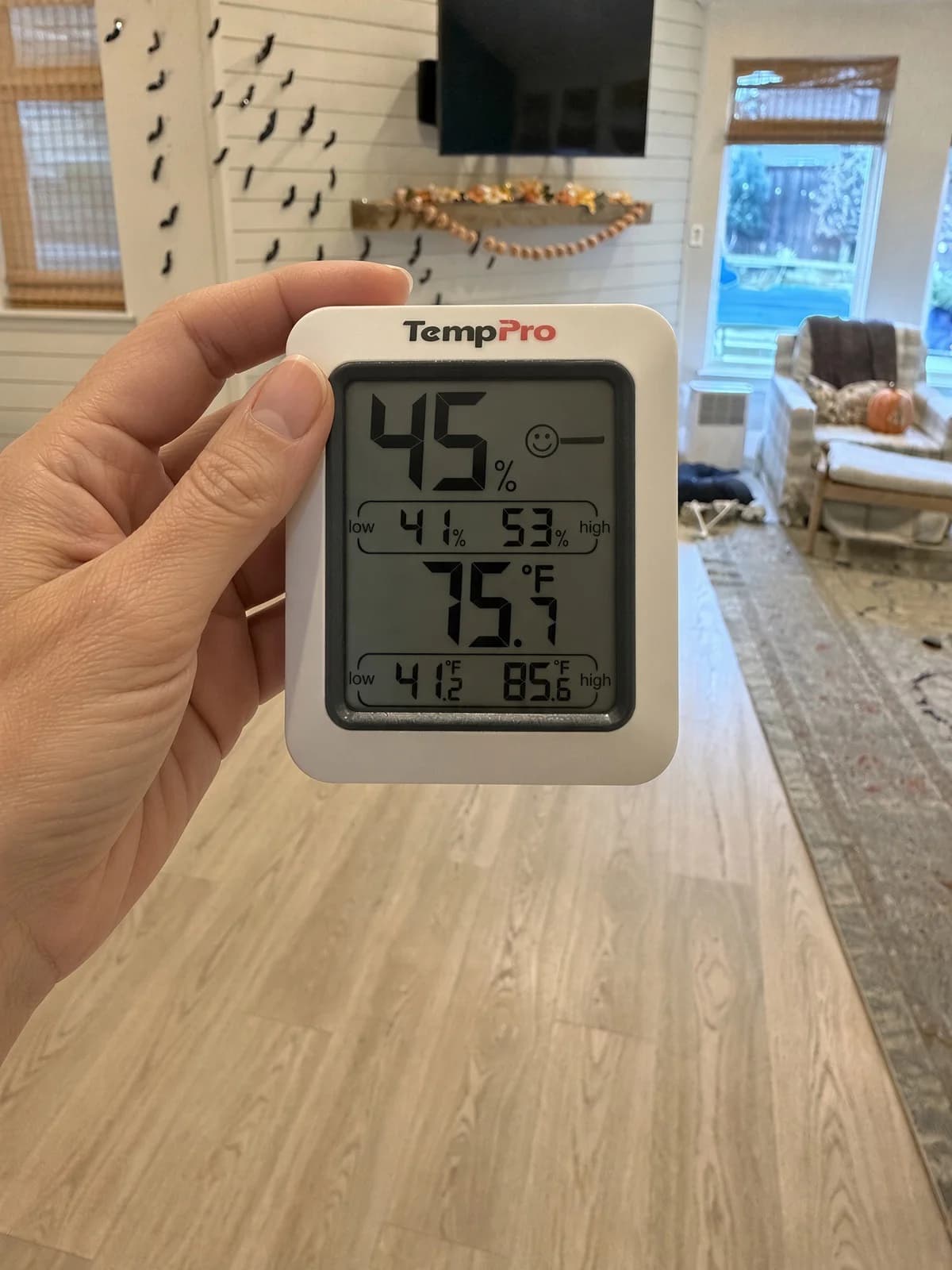
You cannot tell by how the room feels, and you cannot tell by the absence of a stain. Get a humidity meter. Hardware stores sell them. The EPA calls it a moisture or humidity meter, a small tool you use to read relative humidity instead of guessing. Put it in the room where you actually live, not in a closet, and read it more than once. The number moves through the day. One glance after a shower will lie to you. A normal afternoon, and another check later, will not.
Condensation is the other clue, and it is easy to talk yourself out of. If water beads on windows, cold pipes, or an outside wall, the air is wet enough to give that moisture up onto a cooler surface. The EPA says to dry that wet surface rather than wait and see. Waiting is how a clue becomes a colony. The meter tells you the air. The beads tell you a surface already agreed.
What humidity level causes mold, and what should you keep it under?
The guidance gives a ceiling to stay under, and I hold my own house to the lower one.
The CDC says to keep indoor humidity as low as you can, and no higher than 50 percent, all day long. The EPA says to keep it below 60 percent if you can, and ideally between 30 and 50 percent. I use 50 percent as the line I want a home under. Above that, you are giving mold an easier drink, leak or no leak. Below it, you have taken away the easiest thing mold needs. Neither agency is describing a leak. They are describing the air.
What is a humidistat, and how is it different from a humidity meter?
If you add a dehumidifier, the dial that tells it when to turn on is often called a humidistat. That is the control on the machine. It is not the monitor. The humidity meter on the shelf is how you check whether the house is actually staying where you set it. Trust the meter over the feeling of the room, and over the number on the dial if the two disagree. Aim for 50 percent or under.
People mix these two up, and then they think the house is fine because the machine says it is working. A humidistat only tells the dehumidifier when to run. It does not tour the house. It does not know what the bedroom is doing while the machine sits in the hall. The meter is the thing you carry, or the thing you leave in the room you actually sleep in, and read on an ordinary day. If the dial is set to 50 and the meter says 62, the dial is not the boss. The meter is.
A meter is not a mold test, and I do not want you to treat it like one. The CDC does not recommend mold testing as the way to decide what is going on in a home, because there is no federal number that means safe. The meter answers a simpler question. Is the air wet? If the answer is yes, you finally have something more useful than "we never had a leak."
What should you do first if you cannot find a leak?
Buy the humidity meter and read it on an ordinary day, more than once. That is the step. If the number sits above 50 percent, the air is wet enough to feed mold without a single drip. Then you deal with the air. Fan on while you shower. House closed when it is foggy. A dehumidifier if the air conditioner is not doing this job. Those moves come after you have seen the number, not as a shopping list to start with.
If the number is high and you also have a smell, a symptom pattern, or a room that keeps growing something on the surface, then it is time for a person who looks for moisture instead of only looking for a stain. I laid out the questions I ask in how to choose a mold inspector. The hidden mold checklist is there if you want to walk the house yourself before you call anyone. The mold remediation guide is for later, after you know what the water is. Do not start with demolition because a room felt clammy.
If you are trying to sort out whether how you feel fits a damp house, the mold assessment is the place I send people first. It is not a diagnosis. It is a way to stop guessing in your head.
You do not need a puddle to take this seriously. You need a number, and then you need to believe what it says.
Sources
- U.S. Environmental Protection Agency. A Brief Guide to Mold, Moisture and Your Home.
- U.S. Environmental Protection Agency. Mold and Health.
- Centers for Disease Control and Prevention. About Mold.
- World Health Organization. WHO Guidelines for Indoor Air Quality: Dampness and Mould.
- Institute of Medicine. Damp Indoor Spaces and Health. National Academies Press, 2004.
Frequently Asked Questions
Can you have mold without a leak?
Yes. If indoor humidity stays high, mold has the moisture it needs without a roof leak or a pipe leak. A clean ceiling does not prove the air is dry.
Can humidity cause mold in a house?
Yes. Mold needs moisture, and moisture includes water hanging in the air as humidity. Grout, a drywall edge, or a wall behind a cold vent can stay damp enough for mold without ever dripping.
What humidity level causes mold in a house?
I treat anything that sits above 50 percent as wet enough to feed mold. The CDC says keep indoor humidity no higher than 50 percent, all day. The EPA says below 60 percent, ideally 30 to 50 percent. I want a home at or under 50 percent.
Can mold grow without water?
Not without moisture, but the moisture does not have to be a puddle or a drip. Humid air can keep a surface damp enough for mold to grow with no leak anywhere.
Can humidity cause mold in the bathroom?
Yes, especially if the fan is off during the shower. Run the fan while the shower is running, and make sure it vents outside. A fan you switch on after you are dressed has already let that wet air move into the rest of the house.
Can an oversized air conditioner cause mold?
It can leave the air wet enough for it. An air conditioner that is too big cools the room and shuts off before it has pulled the water out of the air. The thermostat can look fine while the air stays damp.
Do I need a dehumidifier if I already have air conditioning?
Sometimes. If the system only runs in short bursts, or the humidity meter stays above 50 percent, the air conditioner is not finishing the drying job. A dehumidifier covers that gap. It is not a prize for people who failed at housekeeping.
How do I know if indoor humidity is too high before I see mold?
Read a humidity meter on an ordinary day, more than once, and notice if water beads on windows, pipes, or cold walls. The meter is not a mold test. It tells you whether the air is wet, and a sticky room and a clean ceiling can exist in the same house.
What is the difference between a humidity meter and a humidistat?
A humidity meter reads the air. A humidistat is the control dial on many dehumidifiers, and it only tells that machine when to run and when to stop. If the dial and the meter disagree, trust the meter.
What should I do first if I cannot find a leak?
Buy a humidity meter and read it on a normal day, more than once. If it sits above 50 percent, deal with the air before you deal with the walls. If you are also sick and unsure the pattern fits, start with the free mold symptoms assessment on this site.

Aubree Felderhoff
Board Certified Holistic Health Practitioner | Mold Recovery Concierge | Certified Primal Health Coach | Master Personal Trainer
Aubree spent 12 years and more than $250,000 searching for answers to a mystery chronic illness that 30-plus doctors couldn't solve. The first culprit was a mycotoxin-overloaded home that triggered a cascade of symptoms nobody could trace back to the source. After finally identifying the connection, remediating, and rebuilding her health, she faced a second exposure years later when water damage in her next home brought the symptoms flooding back.
That second experience is what shaped everything. She found a physician who understood antifungal treatment, completed neuroplasticity training, and fully recovered. Having navigated mold illness twice, from two different sources, she understands both how it starts and how it ends.
Aubree is a Board Certified Holistic Health Practitioner through the American Association of Drugless Practitioners (AADP), a Certified Primal Health Coach, NASM Certified Trainer, and Cooper Clinic Certified. Before mold illness defined her life, she spent 14 years in elite fitness as a national champion collegiate gymnast. She brings that same discipline and evidence-based approach to mold recovery, helping families get clear answers faster, without the decade of wrong turns she endured.
The newsletter
A little hope in your inbox
One email a week from me, with what actually helps families get better. No spam, unsubscribe anytime.
Keep learning with mold illness guides
Start-here pages on symptoms, testing, CIRS, remediation, and hiring an inspector. Free tools and program paths are linked from each guide.
- Mold Illness Symptoms GuideHow mold-related symptoms show up across body systems, why they get misdiagnosed, and when a pattern points to exposure.
- How to Test for Mold IllnessWhy blood testing comes first, where urine mycotoxin and ERMI fall short, and how to order body vs home testing without wasting money.
Need personalized guidance?
Start with free guides and the symptom assessment, or talk with Aubree about the right program path.