
Can Mold Come Back After Remediation?
Quick Answer
Yes, mold can come back after remediation. It returns when the moisture source was never fixed or the removal missed hidden growth. Here is how to tell.
Yes, mold can come back after remediation. It comes back when the moisture source was never fixed, or when the removal missed growth that was hiding the whole time. Here is how to tell which one happened to you.
We spent months displaced while our new house was remediated. Forty-eight hours after we finally moved back in, I found four inches of water pouring down the hallway. My son had overflowed his toilet while we were out for the day. We had barely gotten our life back.
Ours came back months after that flood, hiding behind the vanity and under the flooring we had just replaced. Once you understand why it happens, you can tell whether it is happening to you.
That day, Mitch and I went into full crisis mode. We tore the boys' hallway down to the studs, ripped out baseboards that were two days old, and ran fans and dehumidifiers for weeks. We tested with a moisture meter, got clean readings, and rebuilt. It felt handled. Then months later the symptoms crept back, I got that sinking feeling in my stomach, and I knew before the inspector confirmed it. We had not gotten all of it. This post is everything I wish someone had told me before I trusted a dry reading and moved on. If you paid for remediation and something still feels off, that instinct is worth listening to.
Can mold really come back after remediation?
Yes, and I need you to hear why, because it is not what most people assume. Remediation removes the mold that is in your home today. It does not seal your walls against mold forever. Spores are always drifting through the air, indoors and out, and the EPA is blunt about it: you cannot remove every mold spore from a home, and you do not need to. The ones that stay behind sit there harmless until they land on something wet.
That is the whole game. Mold does not come back because a few spores survived the cleanup. It comes back for one of two reasons: moisture found its way back in, or the mold was never fully gone in the first place. Mine was the second kind. It was living behind that vanity the whole time, waiting for me to stop looking.
So here is the honest version. A good remediation can hold for years, and plenty of families do this once and never think about it again. But it only holds if two things are true: the water problem was actually solved, and every pocket of growth was actually found and pulled out. When mold comes back, one of those two did not happen.
Why does mold come back after remediation?
Almost every time, it comes back because the water did. You can pull out every moldy board, scrub the studs, and haul it all to the curb, but if the leak, the humidity, or the drainage problem that started this is still there, the mold has everything it needs to return. The EPA says it in one line: "The key to mold control is moisture control." And then the part that should be printed on every remediation invoice: "if you clean up the mold, but don't fix the water problem, then, most likely, the mold problem will come back."
This is the piece people miss, and I missed it too. We treat remediation like it is the fix. It is not. Remediation is cleanup. The actual fix is whatever stops the water: the roof, the plumbing, the grading around the foundation, the bathroom fan that was never vented outside, the humidity that quietly sits too high all summer. The CDC recommends keeping indoor humidity no higher than 50 percent and fixing leaks in roofs, walls, and plumbing so mold has nothing to drink. If your crew removed material and never confirmed the water was handled, you paid for a pause, not a solution.
And mold does not wait around. The EPA and CDC both say to dry wet materials within 24 to 48 hours, because that is about how long it takes for mold to start growing. A slow drip under a sink or behind a shower wall clears that bar every single day it goes unnoticed.
What does incomplete or rushed remediation look like?
The second reason mold comes back is that the removal itself was incomplete. Mold grows on almost any organic material as long as moisture and oxygen are present, and a lot of that material is out of sight. When a crew treats what is visible and stops there, the growth you cannot see keeps going. Here is where that breaks down most often.
Hidden growth that never got found
The EPA keeps a specific list of where mold hides: the back side of drywall, wallpaper, or paneling, under carpet and padding, inside walls around pipes, above ceiling tiles, inside ductwork, and on walls behind furniture. If the assessment before your remediation did not go looking in these places, the crew removed what was easy to reach and left what was not. In my case, the mold was behind the vanity and under the new flooring, two of the most common hiding spots there are, and exactly the kind of place a fast job skips.
Porous materials that should have been removed
Some materials cannot be cleaned, only replaced. The EPA notes that absorbent and porous items like carpet, padding, and ceiling tiles often have to be thrown away when they get moldy, because the growth fills the crevices and cannot be fully removed. When a crew tries to salvage these to save time or money, they are leaving living mold in your home.
Skipped containment and cross-contamination
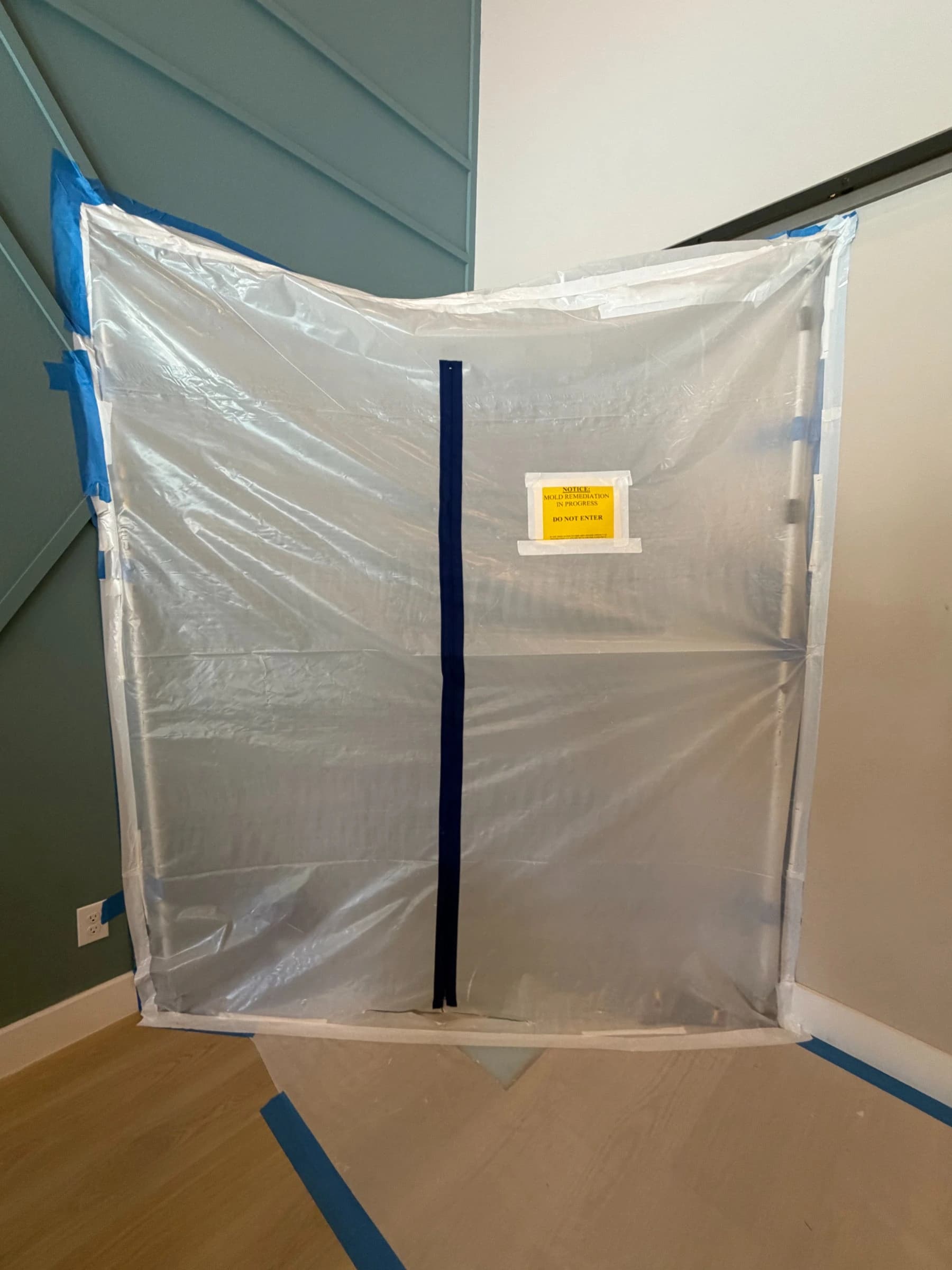
Removing mold kicks spores into the air. Without proper containment, those spores drift into rooms that were clean and settle wherever there is a little moisture, seeding new growth. The EPA specifically warns that disturbing mold, even something as simple as pulling back moldy wallpaper, can release a large burst of spores. A rushed job with no plastic sheeting, no negative air, and no attention to where the dust goes can spread the problem while claiming to solve it.
How fast can mold grow back?
Mold can begin growing back within 24 to 48 hours of a new moisture event. That is the same window that applies to the first growth, and it does not reset just because you remediated. If a pipe bursts, a toilet overflows, or humidity spikes, the clock starts again immediately. This is why a home can pass a clean inspection and then develop mold within days of a new leak, which is exactly what happened to us.
The harder version of this question is how fast mold returns when the moisture was never fixed. In that case there is no dramatic event, just a slow feed of water that keeps a hidden colony alive. You might not see anything for weeks or months, and the first sign is often not visual at all. It is how you feel.
Did the mold come back, or did it never really leave?
This is the distinction that changes everything, and it is the one I got wrong. When symptoms return after remediation, there are two very different explanations, and they lead to different actions.
The first is genuine regrowth or missed growth: mold is physically active in your home again, feeding on moisture that was never resolved. The second is that the mold is gone but your body is still catching up from the original exposure, which can take time even in a clean environment.
Here is how mine played out. After the toilet flood, we did everything fast and hard. We tore the hallway to the studs, dried it for weeks, and the moisture meter read good, so we rebuilt. A moisture meter tells you whether the surface it touches is dry right now. It does not tell you whether there is mold growing behind a vanity you did not open or under flooring you already sealed back up. Months later the symptoms returned, I trusted that sinking feeling, and we brought our inspector back in. Sure enough, there was mold behind the vanity and under the brand new hallway flooring we had just replaced. It was not that the mold came back. We never got all of it. We ended up needing a second remediation to actually finish the job.
That experience is why I take this question so seriously. A dry reading is not the same as a clean home.
Does still feeling sick mean the mold returned?
Not necessarily, and this is where families spiral without needing to. Feeling sick after remediation does not automatically mean mold is growing again. Your body can carry the effects of a past exposure for a while after the source is gone, and recovery is rarely instant. I wrote about what a realistic timeline actually looks like in this post on symptoms after remediation, because so many people assume that lingering symptoms prove the remediation failed when sometimes it just proves healing takes time.
At the same time, symptoms are real information and you should not dismiss them. The move is not to panic and it is not to ignore. The move is to separate the two possibilities with evidence instead of fear. If your home genuinely still has mold, standard clearance results can look fine while you stay sick, which I explained in why your tests keep coming back normal. So the question becomes practical: how do you actually check whether the house is clean, rather than guessing from how you feel.
How do you check whether the remediation actually held?
Verifying remediation is less about one magic test and more about confirming three things in order: the water is fixed, no mold is visible or smellable, and the space can be lived in without symptoms returning. The EPA uses almost exactly this standard to define a finished cleanup. Walk through it honestly.
Start with the water. Before anything else, confirm the moisture source was actually repaired, not just the moldy material removed. If you cannot point to the specific fix, whether it was the roof, the plumbing, the grading, or the ventilation, then the job is not done regardless of how the walls look. A moisture meter and a simple humidity gauge help here. The EPA suggests keeping relative humidity between 30 and 50 percent, and inexpensive meters make that easy to monitor over time rather than in a single snapshot.
Next, use your senses. Visible mold and musty odor should both be absent. If you still catch that damp, earthy smell, that is your home telling you moisture and growth are still present somewhere, which I broke down in this post on what mold smells like. A returning smell after a supposedly finished job is a reason to look harder, not to wait.
Then bring in a professional set of eyes if anything feels off. A qualified inspector can look in the places a moisture meter cannot reach, behind cabinetry, under flooring, inside wall cavities near plumbing. This is the step that finally caught what we missed. If you are choosing someone for this, I put together how to choose a mold inspector, including the questions to ask and the red flags that tell you to keep looking.
One caution on testing. It is tempting to reach for a store-bought air or dust test to prove your home is clean, but these have real limits. There are no federal standards for how much mold is acceptable in a home, so a number on a report does not cleanly translate to safe or unsafe, and the CDC does not recommend mold testing as the way to make these decisions. Verification is about the water, your senses, and a trained inspector far more than it is about chasing a lab value.
What should you do if the mold is back?
If you have worked through the checks above and the mold is genuinely back, the path forward is the same one that works the first time, done properly this time. Find and fix the moisture source first, because without that step you will be here again. Then remove the growth completely, including the hidden and porous material a rushed job leaves behind, with real containment so you are not seeding new rooms. If the job is beyond a small area, this is worth a qualified professional rather than a patch.
And give yourself grace on the health side. A second remediation is discouraging. I have stood in a hallway I had just rebuilt, watching it get torn open again, and it is deflating in a way that is hard to describe. But your body can recover once the exposure is truly gone. That is not a slogan. It is what the research on removing the source consistently shows, and it is what I have watched happen in my own family and in the people I work with. If you want help sorting out whether your symptoms point to active exposure or to a body still healing, that is exactly the kind of thing the mold symptoms assessment is built to start, and it is the work I do inside my program.
You are not overreacting for asking whether the mold came back. You are paying attention. That instinct, followed with the right checks, is what finally gets a home clean and keeps it that way.
Sources
- U.S. Environmental Protection Agency. A Brief Guide to Mold, Moisture and Your Home.
- U.S. Environmental Protection Agency. Mold Cleanup in Your Home.
- U.S. Environmental Protection Agency. Mold Remediation in Schools and Commercial Buildings Guide: Chapter 1.
- Centers for Disease Control and Prevention. About Mold.
- Institute of Medicine. Damp Indoor Spaces and Health (2004), National Academies Press.
- World Health Organization. WHO Guidelines for Indoor Air Quality: Dampness and Mould (2009).
Frequently Asked Questions
Can mold come back after professional remediation?
Yes. Professional remediation removes the mold that is present, but it cannot stop new mold from growing if moisture returns or if hidden growth was missed. A good remediation holds for years when the water source is truly fixed and every pocket of mold was removed. When mold comes back, one of those two things usually failed.
How long after remediation can mold return?
It can return within 24 to 48 hours of a new moisture event, because that is the window in which mold begins to grow on wet material. If the original moisture source was never fixed, mold can quietly regrow over weeks or months without any single dramatic event.
Why do I still smell mold after remediation?
A musty smell after remediation usually means moisture and growth are still present somewhere you cannot see. Odor is one of the clearest signs that a job was incomplete or that a new moisture problem has started. It is a reason to investigate further rather than wait.
Does mold coming back mean the remediation was done wrong?
Often, but not always. Sometimes the removal missed hidden or porous material, or the crew skipped containment and spread spores. Other times the removal was fine but the underlying water problem was never repaired, so mold simply grew back. Either way, the fix is the same: address the moisture and finish the removal.
Can mold grow back in the same spot?
Yes. If the moisture that caused the original growth is still there, mold will often return to the same location. It can also appear nearby if spores spread during removal and settle on another damp surface.
How can I tell if the mold came back or if I am still sick from the old exposure?
Check the home with evidence rather than guessing from symptoms. Confirm the water source was fixed, look and smell for any signs of mold, and have a qualified inspector check hidden areas. If the home is genuinely clean, lingering symptoms may reflect a body still recovering from the original exposure, which takes time.
Do I need to test my house again after remediation?
Verification matters more than testing. There are no federal standards for acceptable mold levels, and the CDC does not recommend mold testing as the basis for these decisions. Confirming the moisture is fixed, checking for visible mold and odor, and having a professional inspect hidden areas tells you more than a store-bought test.
Can fixing a leak stop mold from coming back?
Fixing the moisture source is the single most important step in stopping mold from returning. The EPA calls moisture control the key to mold control. Removing mold without fixing the water problem almost always leads to regrowth.
Is it normal to feel sick months after remediation?
It can be. Recovery from mold exposure is not always instant, and some people carry symptoms for a while after the source is gone. That said, returning symptoms can also signal that mold is active again, so it is worth verifying the home is truly clean rather than assuming either explanation.
How do I keep mold from returning after remediation?
Control moisture. Keep indoor humidity no higher than 50 percent, fix leaks quickly, dry any wet materials within 24 to 48 hours, vent bathrooms and dryers to the outside, and address drainage around the foundation. Mold cannot grow without water, so managing moisture is what keeps a remediated home clean.

Aubree Felderhoff
Board Certified Holistic Health Practitioner | Mold Recovery Concierge | Certified Primal Health Coach | Master Personal Trainer
Aubree spent 12 years and more than $250,000 searching for answers to a mystery chronic illness that 30-plus doctors couldn't solve. The first culprit was a mycotoxin-overloaded home that triggered a cascade of symptoms nobody could trace back to the source. After finally identifying the connection, remediating, and rebuilding her health, she faced a second exposure years later when water damage in her next home brought the symptoms flooding back.
That second experience is what shaped everything. She found a physician who understood antifungal treatment, completed neuroplasticity training, and fully recovered. Having navigated mold illness twice, from two different sources, she understands both how it starts and how it ends.
Aubree is a Board Certified Holistic Health Practitioner through the American Association of Drugless Practitioners (AADP), a Certified Primal Health Coach, NASM Certified Trainer, and Cooper Clinic Certified. Before mold illness defined her life, she spent 14 years in elite fitness as a national champion collegiate gymnast. She brings that same discipline and evidence-based approach to mold recovery, helping families get clear answers faster, without the decade of wrong turns she endured.
The newsletter
A little hope in your inbox
One email a week from me, with what actually helps families get better. No spam, unsubscribe anytime.
Recommended Products
Recommended Products may include affiliate links. See our Affiliate Disclosure for details.
 Brain Retraining
DNRS (Dynamic Neural Retraining System)
A neuroplasticity-based program that helps rewire limbic system dysfunction caused by mold exposure, trauma, and chronic illness. Self-paced video training you can do from home.
 Full Support
The Complete Mold Recovery Program
For families who are done figuring it out alone and want someone in their corner through every phase of recovery.
 Aubree's Protocol
Mold Recovery Supplement Protocol
Professional-grade supplements curated by Aubree for mold detox and recovery. Available in Adult and Youth formulations through Fullscript with practitioner pricing.
 Nervous System Reset
Primal Trust Academy & Community
Brain retraining + nervous system regulation program for chronic illness recovery. The missing piece for mold patients whose bodies stay stuck in stress mode.
Keep learning with mold illness guides
Start-here pages on symptoms, testing, CIRS, remediation, and hiring an inspector. Free tools and program paths are linked from each guide.
- Mold Remediation GuideWhat proper remediation looks like, how to separate inspection from the fix, and what to do when you are still sick after the work.
- Mold Illness Symptoms GuideHow mold-related symptoms show up across body systems, why they get misdiagnosed, and when a pattern points to exposure.
Need personalized guidance?
Start with free guides and the symptom assessment, or talk with Aubree about the right program path.