
Mold Fatigue: Why You're Exhausted No Matter How Much You Sleep
Quick Answer
Mold-related fatigue does not respond to sleep, rest, or caffeine. Here is why mycotoxins drain your energy and what recovery actually looks like.
What makes mold fatigue different from regular tiredness?
Most of us know what it feels like to be genuinely tired. You pull a late night, you have a rough week, your newborn has you up at three in the morning. But when you finally get a good stretch of sleep, you feel it. You wake up restored, even if just a little. The nap helps. The long weekend helps.
Mold fatigue does not work that way.
When I was living in our mold-contaminated home, I was postpartum with my second son. At first, I chalked the exhaustion up to that. But my baby started sleeping through the night, and I was still waking up every single morning feeling as though I had not slept at all. Not groggy, not slow to start. Completely depleted. Like I had been up the entire night and was running on nothing.
The tiredness I felt was not "I need a nap" tired. I am talking about the energy required to walk from my bedroom to the kitchen to get a snack for my toddler. That was hard. Getting up to use the bathroom was hard. I was a former collegiate gymnast who had run boot camps and personal training sessions for years, and I was struggling to lift my head off the pillow.
That gap, between who you were and what your body will now allow you to do, is one of the clearest signs that something is genuinely wrong.
The Day Sitting Became Too Hard: How Laying Down Kept Me Going
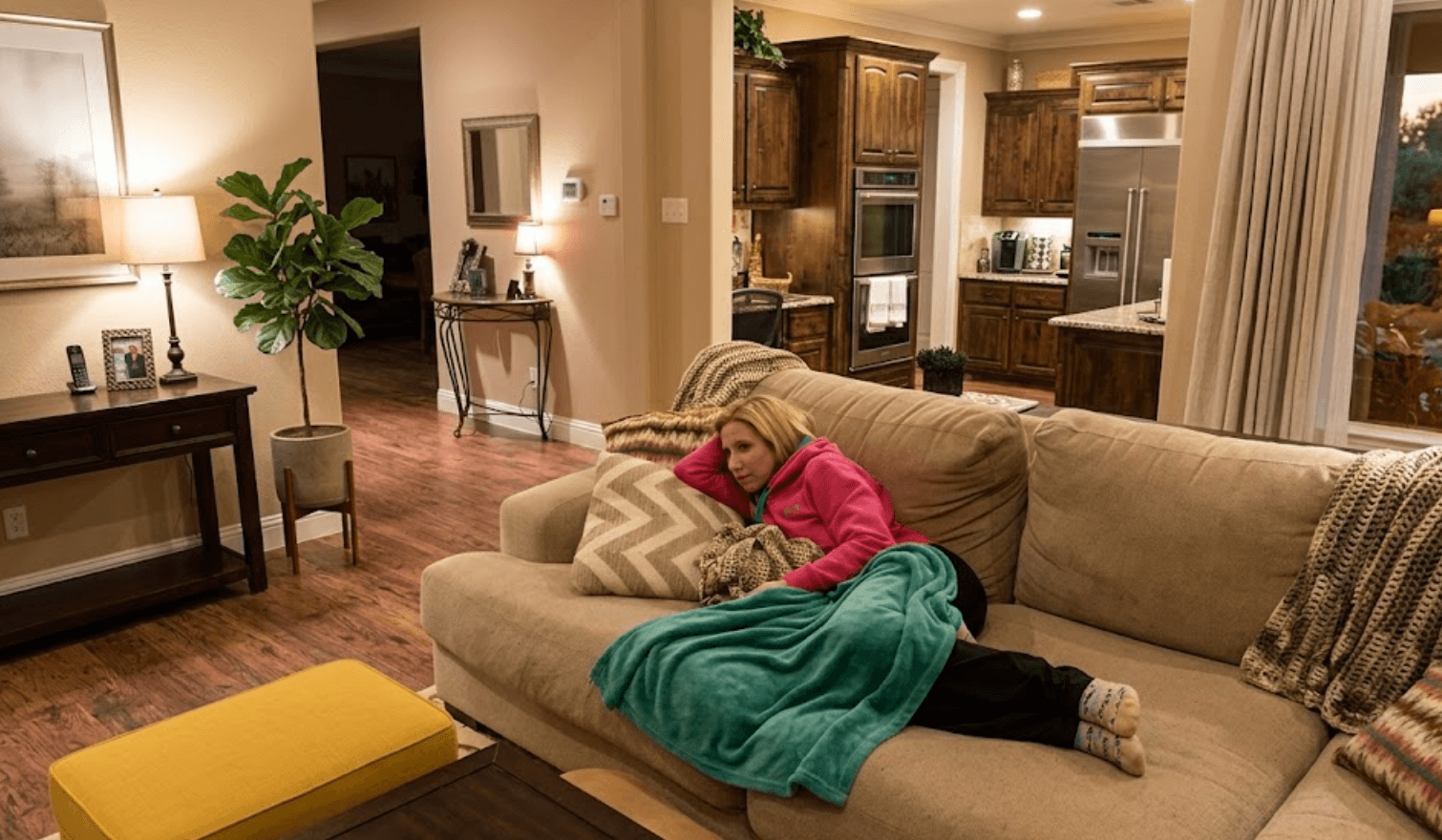
Here is the thing that finally told me this was not normal tiredness. Every chance I had, I was not just collapsing onto the couch. I was laying flat, anywhere I could.
My boys would be playing on the floor and I would be on the floor next to them, flat on my back, watching them. Not napping. I could not actually sleep. Just existing horizontally because sitting upright took too much out of me. In the car, if I was not driving, I was laid back with my eyes barely open. When I was driving, my head was pushed all the way back against the headrest and I felt like I could barely move my body.
That is not tired. That is your body using every bit of available energy just to keep you functional, with nothing left for anything else.
Why mold causes such severe fatigue
Mycotoxins, the toxic compounds produced by certain mold species, disrupt almost every system in the body. But fatigue is often the first and most persistent symptom because of how mycotoxins interfere with mitochondrial function.
Your mitochondria are the energy-producing centers of your cells. When mycotoxin exposure is ongoing, research shows they are directly impaired. Trichothecene mycotoxins are well documented inhibitors of protein synthesis at the cellular level, as reviewed in Fung and Clark's toxicological overview, which means cells struggle to build and repair the machinery they need to function. When your cells cannot produce energy efficiently, everything downstream suffers: your muscles, your brain, your immune function, your sleep quality.
That is why mold fatigue feels systemic. It is not just that you are sleepy. It is that your body is genuinely running low on the fuel it needs to operate.
There is also the inflammation factor. Mycotoxin exposure triggers a significant inflammatory response. Chronic systemic inflammation is strongly associated with fatigue states, as documented across multiple published studies looking at conditions like how mycotoxins affect the body. Your immune system is expending enormous resources trying to respond to an ongoing threat, and that expenditure shows up as exhaustion.
Finally, mold disrupts sleep architecture. Even when you are in bed for eight or ten or twelve hours, you are not cycling through the restorative stages of sleep the way a healthy person does. The result is that you accumulate hours of sleep without ever feeling rested.
Why caffeine eventually stops working
For years, I managed with caffeine. A lot of it. When you are that exhausted and you have small kids and a life to keep running, you do what you have to do. And for a while, caffeine helped, at least enough to get through a day.
But eventually, even that stopped working.
This is actually a well-documented pattern in people with significant mycotoxin loads. Caffeine works by blocking adenosine receptors, the receptors that signal to your brain that you are tired. But when the underlying fatigue is driven by mitochondrial dysfunction and systemic inflammation, you are not dealing with a simple adenosine buildup. You are dealing with cells that genuinely cannot produce adequate energy. Blocking the tired signal does not fix the actual problem of insufficient fuel. Once the inflammation and cellular disruption reach a certain level, caffeine simply cannot compensate.
When I reached that point, where I was drinking more caffeine than ever and it was doing essentially nothing, I knew something was very wrong. If you are there right now, that complete resistance to caffeine is worth paying attention to.
Why moving out of mold was not enough to fix the fatigue
Once I figured out that mold was at the root of what was happening to me, I expected that getting away from it would be the turning point. We moved. I started treatment. I waited to feel better.
The exhaustion stayed.
Here is what I did not understand at the time: the first rule of toxicology is to get the patient away from the toxin, or the toxin away from the patient. Moving out of a moldy environment removes the ongoing exposure, which matters enormously. But if mold has been in your body long enough, it colonizes. It moves deep into your tissues, your sinuses, your gut, your lungs, and it sets up residence there. Once that happens, you are no longer just being exposed from your environment. You are being exposed from the inside, every day.
I had good days once I was out of the mold environment, because the external source of new exposure was gone. But the deep, relentless fatigue persisted because I was not treating the colonized mold inside my body. I had no idea that was even something I needed to address. The protocol I was following at the time was not designed to reach it.
That fatigue did not lift until I found and committed to a protocol that actually addressed internal colonization. More on what that looked like at why you can still be sick after leaving a moldy home.
The part that broke my heart: I had forgotten what normal felt like
After years of living in that level of exhaustion, something quietly happened that I did not even notice at the time. I stopped knowing what it felt like to not be exhausted.
I grew up as an athlete. I had always had too much energy, honestly. I was the person who could not sit still, the one bouncing off walls at practice, the one who had to be told to slow down. And at some point during those years of mold illness, I completely lost the memory of what that felt like. Not dramatically. Not in one moment I could point to. It just slipped away, so slowly that I did not feel it go.
I had been exhausted for so long that I assumed exhaustion was just my baseline now. I told myself this was adulthood. This was motherhood. Plenty of people around me were tired too. Everyone talked about being tired. So I stopped expecting anything different and I stopped asking for anything different. I just learned how to be a sick person and called it life.
That is the part that breaks my heart the most when I look back. Not the worst days, not the floor days, not the days I could not get up. It is the quiet surrender. The moment I stopped grieving who I used to be because I had simply forgotten her.
When I finally treated the colonized mold with the right protocol and my energy started to come back, I did not recognize it at first. I did not trust it. I kept waiting for the crash, kept bracing for the day my body would remind me that this was not real, that I was still sick, that I had just had a good run. But the crash did not come.
I remember the first time I finished a full day and realized I had not dragged myself through it. That I had moved through my day with something left over at the end. That I had laughed easily, had played with my boys without counting the cost, had gone to bed that night feeling like a person instead of a body that had barely survived the day. It caught me completely off guard. I sat with it for a long time, trying to figure out what was different, and then I realized: I felt like myself. For the first time in over a decade, I felt like the person I used to be.
I had no idea what I had been missing because I had been missing it for so long.
If you are currently in that place, where exhaustion is just your normal and you have stopped expecting anything different, where you have quietly surrendered to the idea that this is just who you are now, I want you to hear this: that is not your baseline. That is not who you are. That version of you that had energy and joy and pep and presence, she is still there. She has just been buried under something that has a name and a cause and a solution.
Fatigue that does not respond to sleep, rest, or caffeine is not a character flaw. It is not weakness. It is not the price of motherhood or aging or stress. It is a symptom. And symptoms have causes, and causes can be treated.
How to tell if your fatigue might be mold-related
Mold-related fatigue tends to cluster with other symptoms. In isolation, fatigue is easy to explain away. But if you are dealing with several of these at once, the picture becomes harder to ignore.
Common accompanying symptoms include brain fog and memory issues, which I experienced so severely that I was tested for early-onset dementia. I also had migraines, joint and muscle pain that was worst first thing in the morning, unexplained hair loss, skin issues, chronic congestion, and visual disturbances including worsening night vision. Sleep disruption was constant, which compounded the fatigue into something that felt unsurvivable on the worst days.
The combination of fatigue that does not respond to rest alongside multiple other unexplained symptoms is a pattern worth investigating seriously. A blood test looking for mycotoxin antibodies is usually the most straightforward starting point. You can learn more about how testing works at blood testing vs environmental testing for mold.
If you want to get a clearer picture of whether your symptom profile fits mold illness, the mold symptom assessment at Mold Free Mom walks you through exactly that.
What recovery from mold fatigue actually felt like, and what is possible for you
I will not tell you recovery was instant or that there was a single moment where everything snapped back. It was more like a slow return of something I had written off as gone.
The first signs were small. I started finishing tasks without having to rest in the middle of them. I started having days where I did not need to immediately lie down after getting the boys sorted. I started waking up and feeling, not great at first, but less like I had been through something the night before. And then one day I realized the crash I kept bracing for had never come. I had just been getting better, quietly, steadily, one day at a time.
Within weeks of starting the right protocol, I noticed a difference. Not a dramatic overnight transformation, but real, measurable change. The kind of change that after a decade of trying everything and feeling nothing shift, made me sit down and cry. Within months, I felt better than I had in twelve years. And I kept going.
Here is what I want you to understand, because I spent years believing none of this was possible for me: recovery from mold-related fatigue is not about willpower. It is not about trying harder or pushing through or finding the right supplement to add to a protocol that is already not working. It is about having the right tools, used in the right order.
That is the piece that was missing for me for so long. I was working harder than almost anyone I knew. I was doing everything right on paper. But I was doing things in the wrong sequence, targeting the wrong problem, and fighting a battle that could not be won until I addressed what was actually happening inside my body. Once I understood that, and once I got the right protocol in place, everything changed.
It does not have to take twelve years. It does not have to cost you hundreds of thousands of dollars. It does not have to mean living in fear of exposure for the rest of your life or depending on protocols that keep you managing symptoms instead of actually healing. The body is designed to heal. When you give it the right tools in the right order, it does exactly that.
If you are exhausted in a way you cannot explain and cannot fix, and you are ready to stop guessing and start with a clear, structured path forward, that is exactly what the Mold Free Mom program is built to give you. You do not have to figure this out alone, and you do not have to stay stuck.
Sources
- Fung, F., & Clark, R. F. (2004). Health effects of mycotoxins: a toxicological overview. Journal of Toxicology: Clinical Toxicology, 42(2), 217-234.
- Thrasher, J. D., & Crawley, S. (2009). The biocontaminants and complexity of damp indoor spaces: more than what meets the eyes. Toxicology and Industrial Health, 25(9-10), 583-615.
- Brewer, J. H., Thrasher, J. D., Straus, D. C., Madison, R. A., & Hooper, D. (2013). Detection of mycotoxins in patients with chronic fatigue syndrome. Toxins, 5(4), 605-617.
- Sava, V., Reunova, O., Velasquez, A., & Sanchez-Ramos, J. (2006). Can low level exposure to ochratoxin-A cause parkinsonism? Journal of the Neurological Sciences, 249(1), 68-75.
- U.S. Environmental Protection Agency. (2024). Mold and health. EPA Indoor Air Quality.
Frequently Asked Questions
Can mold exposure cause extreme fatigue?
Yes. Mycotoxins produced by indoor mold species directly impair mitochondrial function and trigger systemic inflammation, both of which cause severe, persistent fatigue. This type of fatigue does not respond to rest or sleep the way normal tiredness does.
Why am I still exhausted even after sleeping 10 or 12 hours?
Mold-related fatigue is not caused by lack of sleep. It is caused by cellular dysfunction driven by mycotoxin exposure. Your body is not producing energy efficiently at the cellular level, which means no amount of sleep fully restores you. Until the underlying mycotoxin load is addressed, the fatigue persists regardless of how long you are in bed.
Is fatigue the first sign of mold illness?
For many people, yes. Fatigue was the very first symptom I noticed, and it is commonly the first thing people report. The challenge is that fatigue is also associated with dozens of other conditions, which makes it easy to explain away and easy for doctors to miss the mold connection.
Why did caffeine stop helping my fatigue?
Caffeine works by blocking adenosine receptors that signal tiredness. When fatigue is driven by mycotoxin-related mitochondrial dysfunction, the underlying cause is cellular energy failure, not just adenosine buildup. Once the cellular disruption reaches a significant level, caffeine cannot compensate for the actual energy deficit.
Can you still be fatigued from mold after leaving a moldy home?
Yes. If mold has colonized inside the body, you are still being exposed internally even after removing the environmental source. Moving out of a moldy home removes new external exposure but does not address mold that has already taken up residence in body tissues. This is why many people continue to experience fatigue and other symptoms long after leaving a contaminated environment.
What does mold fatigue feel like compared to regular tiredness?
Regular tiredness resolves with rest. Mold-related fatigue does not. It feels like waking up already exhausted, like a flu that never fully arrives but never fully leaves. Simple tasks like walking across the house or standing in the shower require effort that should not be necessary. Many people describe it as feeling like a zombie or like the life has been drained out of them.
How long does mold fatigue last?
That depends entirely on whether the underlying cause is identified and treated. Without addressing the mycotoxin load and any internal colonization, mold fatigue can persist for years or even decades, which was my experience. With the right treatment protocol targeting colonized mold, many people begin noticing improvement within weeks.
What is the connection between mold and mitochondrial dysfunction?
Mycotoxins, particularly trichothecenes and ochratoxin A, have been shown in research to impair mitochondrial function at the cellular level. Since mitochondria are responsible for producing the energy that powers every cell in the body, this impairment results in widespread energy deficits that show up as profound fatigue, brain fog, muscle weakness, and poor recovery from any physical exertion.

Aubree Felderhoff
Board Certified Holistic Health Practitioner | Mold Recovery Concierge | Certified Primal Health Coach | Master Personal Trainer
Aubree spent 12 years and more than $250,000 searching for answers to a mystery chronic illness that 30-plus doctors couldn't solve. The first culprit was a mycotoxin-overloaded home that triggered a cascade of symptoms nobody could trace back to the source. After finally identifying the connection, remediating, and rebuilding her health, she faced a second exposure years later when water damage in her next home brought the symptoms flooding back.
That second experience is what shaped everything. She found a physician who understood antifungal treatment, completed neuroplasticity training, and fully recovered. Having navigated mold illness twice, from two different sources, she understands both how it starts and how it ends.
Aubree is a Board Certified Holistic Health Practitioner through the American Association of Drugless Practitioners (AADP), a Certified Primal Health Coach, NASM Certified Trainer, and Cooper Clinic Certified. Before mold illness defined her life, she spent 14 years in elite fitness as a national champion collegiate gymnast. She brings that same discipline and evidence-based approach to mold recovery, helping families get clear answers faster, without the decade of wrong turns she endured.
The newsletter
A little hope in your inbox
One email a week from me, with what actually helps families get better. No spam, unsubscribe anytime.
Keep learning with mold illness guides
Start-here pages on symptoms, testing, CIRS, remediation, and hiring an inspector. Free tools and program paths are linked from each guide.
- How to Test for Mold IllnessWhy blood testing comes first, where urine mycotoxin and ERMI fall short, and how to order body vs home testing without wasting money.
- Mold Illness Symptoms GuideHow mold-related symptoms show up across body systems, why they get misdiagnosed, and when a pattern points to exposure.
Need personalized guidance?
Start with free guides and the symptom assessment, or talk with Aubree about the right program path.