
Should You Remove Fluoride From Your Tap Water?
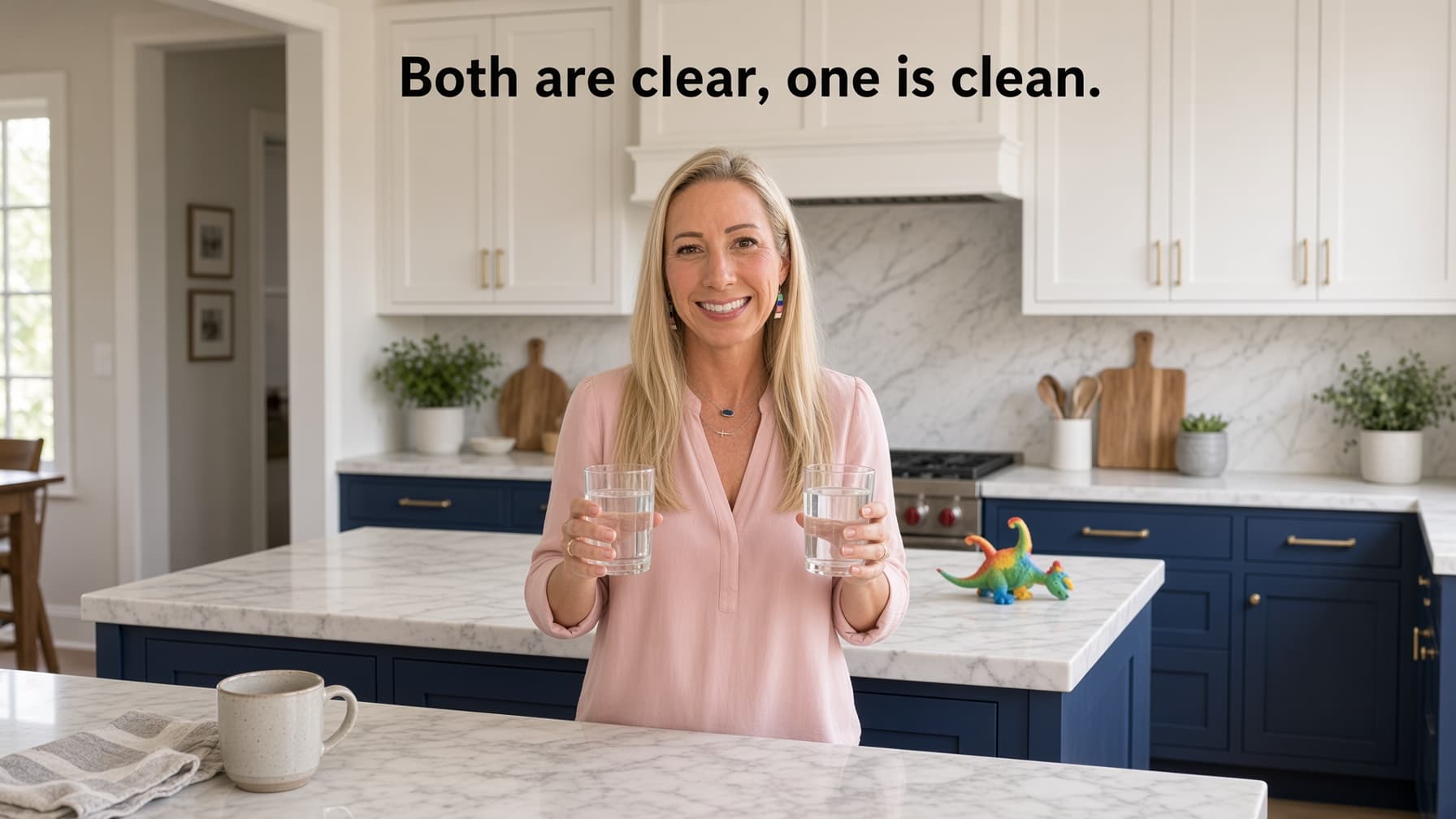
Quick Answer
I'd take fluoride out of my family's drinking water. Here's what the research says, what else can be in your tap, and the full water setup we use at home.
I'd take fluoride out of my family's drinking water, and reverse osmosis is how I'd do it. Below is what the research says about fluoride, what else can be in your tap water, and the softener and reverse osmosis setup we use at home. If you're healing from mold, this is one more load you can lighten.
Clean water is one of the simplest places to start, whether you're healing from mold or just trying to keep your family well. Everyone in your house drinks it, cooks with it, bathes in it, and breathes the steam from it every single day. We put so much energy into the things we can see, like the mold on the grout, the musty closet, the stain on the ceiling. The water we can't see barely gets a second look, and it touches everything.
This post contains affiliate links. If you purchase through these links, we may earn a small commission at no extra cost to you.
The glass of water that got my attention
For a long time I never thought twice about my water. I'd fill a glass with ice, and it tasted like nice, cold water. Nothing to worry about.
Then I started noticing something. If I left that same glass on the counter or my nightstand overnight, it tasted completely different in the morning. Once the ice melted and the water warmed up, it tasted like a swimming pool. That sharp, chlorine taste I could never pick up when it was ice cold was suddenly impossible to miss.
That was my wake-up call. If I could taste it once the cold stopped covering it up, it had been there the whole time. And if it was in my drinking water, it was in our showers, our baths, and everything I cooked with. That one glass is what made me start paying real attention to what came out of our tap. I'm telling you this because I'd bet a lot of you have had the same glass sitting on the same nightstand.
Why does water matter more than we think?
Your body is mostly water, and it counts on a steady supply to do just about everything, including the everyday work of clearing out what it doesn't need. If your system is already carrying a heavy load from mold exposure, inflammation, or a chronic condition, the last thing you want is to add to that load every time you fill a glass. Water isn't a supplement or a protocol. It's what you take in more of than anything else, all day, every day.
Tap water in most places is treated to meet safety standards, and I'm glad it is. The EPA sets legal limits for a long list of contaminants in public water systems, and those rules protect a lot of people. But "meets standards" and "ideal for a body that's trying to recover" aren't always the same thing. A standard is written for the whole population. It isn't written for one body that may already be working harder than it should.
Is mold the only toxin in our homes?
When you've lived through mold illness, it's easy to see mold as the one enemy. It's a big one, but it's rarely the only one. Most homes carry a mix of exposures that add up over time, and most of them are so ordinary that nobody thinks of them as exposures at all.
Start with fragrances and cleaning products. The EPA explains that many household products, including cleaners, air fresheners, and furnishings, release volatile organic compounds into the air inside your home. Nonstick cookware, stain-resistant fabrics, and some food packaging can contain PFAS. The EPA describes them as persistent because they break down so slowly, which is where the nickname "forever chemicals" comes from. Flame retardants are another one, and the National Institute of Environmental Health Sciences notes they show up in furniture, mattresses, electronics, and building materials. Then you've got pesticides and lawn chemicals that ride in on shoes and paws, plus the off-gassing from new furniture and new building materials.
I'm not telling you this to scare you. I've written before about why mold affects some people and not others, and part of the answer is that every body is carrying a different total load. Your body handles all of it together, so lowering your exposure anywhere, including your water, lightens the whole pile. You don't have to fix everything at once. You just have to stop pretending the pile isn't there.
What can actually be in tap water?
What's in your water depends a lot on where you live and how old your plumbing is. Most city systems disinfect with chlorine or chloramine, which the EPA describes as a common disinfectant used to keep germs out of the water on its way to your house. I'm glad that happens. The tradeoff is that disinfectants react with natural material in the water and form byproducts, and the EPA regulates those under its disinfection byproducts rules.
Lead depends more on your house than on your city. The EPA explains that lead gets into drinking water when plumbing that contains lead corrodes, and the most common sources are lead pipes, faucets, fixtures, and solder, especially in older homes. PFAS can show up in tap water too, because once they get into the environment they tend to stay there. And if you're on a private well, the picture changes again. The EPA's list of regulated drinking water contaminants includes nitrate, arsenic, and bacteria, and on a well, nobody is checking those for you.
Here's the part that matters most to me. Most of this has no color, taste, or smell, at least not when the water is ice cold. My pool-water glass was the exception, not the rule. You can't count on your senses to tell you what's in your water, which is why the next step is finding out instead of guessing.
Why take fluoride out of your water?
I'm going to be direct about this one. I'd take fluoride out of your family's drinking water, and I'm not going to dance around why.
What has fluoride been linked to in kids?
In 2024, the National Toxicology Program concluded, with moderate confidence, that fluoride exposure above 1.5 mg/L is associated with lower IQ in children. The same page raises a concern that some pregnant women and children may already be getting more fluoride than they need, because it now comes from so many places at once: tap water, foods and drinks made with it, tea, toothpaste, floss, and mouthwash. A 2025 meta-analysis in JAMA Pediatrics pooled 74 studies. In the 13 that measured fluoride in each person's urine, every 1 mg/L increase was associated with a 1.63-point drop in children's IQ.
Then a federal judge weighed in. In September 2024, the court in Food & Water Watch v. EPA ruled that fluoridation at 0.7 mg/L, the level the US considers optimal, "poses an unreasonable risk of reduced IQ in children," and that the EPA is obliged to take regulatory action. That's the everyday level in fluoridated towns, not some extreme exposure.
Does fluoride build up in the body?
It does. A study in Caries Research measured fluoride in the pineal glands of 11 older adults after death and found it at levels hundreds of times higher than in their muscle. The pineal is the tiny gland that makes melatonin. The National Research Council's 2006 review wrote that fluoride "is likely to cause decreased melatonin production," though it noted this hadn't been studied directly in people yet. It also called fluoride "an endocrine disruptor in the broad sense of altering normal endocrine function," and said high fluoride intake appears to make the effects of low iodine worse. The same report noted that fluoride accumulates in bone over time and concluded that exposure at the EPA's 4 mg/L limit puts children at risk of severe enamel fluorosis.
You can see it on teeth, too. CDC survey data found that 41% of kids aged 12 to 15 had some dental fluorosis in 1999 to 2004, up from about 23% in 1986 to 1987.
If fluoride works on teeth, why are we drinking it?
This is the part that gets me. The CDC's own fluoride recommendations say fluoride's "predominant effect is posteruptive and topical." In plain words, it does most of its work after the teeth come in, from small amounts that stay in the mouth. That's why I'd rather get it from a toothbrush than from every glass of water all day.
Who has already stopped?
A 2024 review in Annali di Igiene found water fluoridation "almost entirely absent" in the European Union outside Ireland and parts of Spain. Here at home, Utah and Florida passed laws in 2025 banning it from public water, Florida through SB 700. The CDC still recommends 0.7 mg/L, but most of the EU doesn't add it, and two states now ban it.
If you're mixing formula, the CDC says powdered or concentrated formula mixed with fluoridated water may raise a baby's chance of mild dental fluorosis when formula is the main food. It suggests using low-fluoride bottled water labeled deionized, purified, demineralized, or distilled some of the time. Getting fluoride out of your tap at home is simple, and reverse osmosis is how I'd do it.
Do pitcher and carbon filters remove fluoride?
Mostly, no, and this one surprises people. The CDC's guide to home water filters explains that the carbon filters in most pitchers and refrigerators are designed mainly to improve taste and odor, and that reverse osmosis is the type of system that may reduce fluoride. The American Dental Association's own Fluoridation Facts says the same thing from the other direction: almost all reverse osmosis systems remove most of the fluoride, most carbon filters don't, and softening doesn't significantly change fluoride levels. So if fluoride is one of your reasons, a pitcher won't get you there. Reverse osmosis is one of the most dependable ways to take it out.
How do you find out what's in your water?
You don't have to guess, and I'd encourage you not to. Start by looking up your local water quality report. Community water systems publish an annual Consumer Confidence Report for their customers, and it lists what was found in your water and how that compares to the legal limits. It's not exciting reading, but it's your water, and it's free.
If you're on a well, you'll need to test it yourself, because no one else is required to. The EPA says private wells aren't regulated by the federal government, and it's clear that well owners are responsible for the safety of their own water. The nitrates, the arsenic, the bacteria, all of it is on you to check. The CDC suggests contacting your health department for advice on what to test for and how to find a state-certified lab.
Even on city water, I like getting an independent test. The report tells you what left the treatment plant. It can't tell you what happened to that water between the plant and your kitchen, or what your own pipes added along the way. A test from your own tap shows you your actual home, not the city average.
And pay attention to the clues your house is already giving you. Spots on glassware, scale on fixtures, dry skin or hair after showers, or a pool smell when a glass sits out are not proof of anything, but they're information. Once you know what you're working with, you can build a system that fits your home instead of guessing.
Step one: why start with a whole-home softener?
A whole-home system sits where water enters the house, so everything downstream gets treated, not just the kitchen faucet. That matters to me because of the shower. Warm water and steam are how a lot of what's in your water ends up in your lungs and on your skin, and a drinking-water filter at one sink does nothing for that.
The softener is the first piece. The US Geological Survey explains that hardness comes mainly from dissolved calcium and magnesium, and that hard water is what leaves the crusty buildup on fixtures and the spots on your glassware. The EPA's filtration fact sheet describes softeners as the tool for pulling those minerals out. It protects your plumbing and appliances, including your water heater, dishwasher, and washing machine, from the buildup that shortens their life. It helps your soap work, since the CDC notes that hard water can keep soap from lathering. And it protects the filters downstream. Hard water is tough on reverse osmosis membranes, so softening first helps them work better and last longer.
Here's what a softener doesn't do. It generally doesn't change fluoride levels, and it isn't designed to pull out chlorine or PFAS. That's why families pair it with whole-home carbon filtration, so the chlorine taste and some other chemicals come out at every tap and shower. The EPA notes that activated carbon is one of the technologies that can reduce PFAS, alongside reverse osmosis and ion exchange.
One catch I want you to know about. The CDC warns that a whole-home filter that removes chlorine or other disinfectants can let more germs grow in your plumbing, so weigh that before you take the chlorine out of the whole house. It's one more reason I like having a real person look at your water and your setup instead of ordering something off a shelf.
Step two: what does reverse osmosis with a remineralizer do?
Reverse osmosis, or RO, pushes water through a very fine membrane. Water molecules get through and a wide range of contaminants get left behind. The CDC's overview of home water treatment says RO systems remove lead and copper and may reduce arsenic, fluoride, nitrate, and other contaminants, and the EPA lists reverse osmosis among the methods that reduce PFAS. Most families put RO on the water they drink and cook with, usually at the kitchen sink or the fridge line, because that's where most of what you swallow comes from.
The tradeoff is that RO takes out the good minerals along with the bad. The same CDC page notes that RO may also reduce calcium and magnesium, and the World Health Organization has published a review on nutrients in drinking water. It came out of a 2003 expert meeting on the possible health effects of drinking water with the minerals taken out over the long term, like desalinated water and possibly some membrane-treated water, and on how best to put minerals back. It doesn't settle the question, but it's one reason I like a remineralizer after the RO. It's a small final stage that puts some calcium, magnesium, and other minerals back into the water. What I can tell you for sure is that it makes the water taste cleaner and fuller, so everyone in the house actually wants to drink it, and that it returns some of the minerals the membrane took out. Water your kids will actually drink is the goal.
Put together, a softener up front and RO with a remineralizer at the tap gives you water that's easier on your home and that your family will reach for. These days a glass left on my nightstand tastes like it came from a fresh spring, even the next morning. No pool water. Just water.
What do I use at home?
We have the full ONIT system at our house: the softener, the reverse osmosis, and the remineralizer. It's the setup I point families to when they ask where to start. ONIT Home is a veteran-owned water company out of Argyle, Texas, and you can find them in my store. They start with a free in-home water test, so you see what's in your own tap before you buy anything.
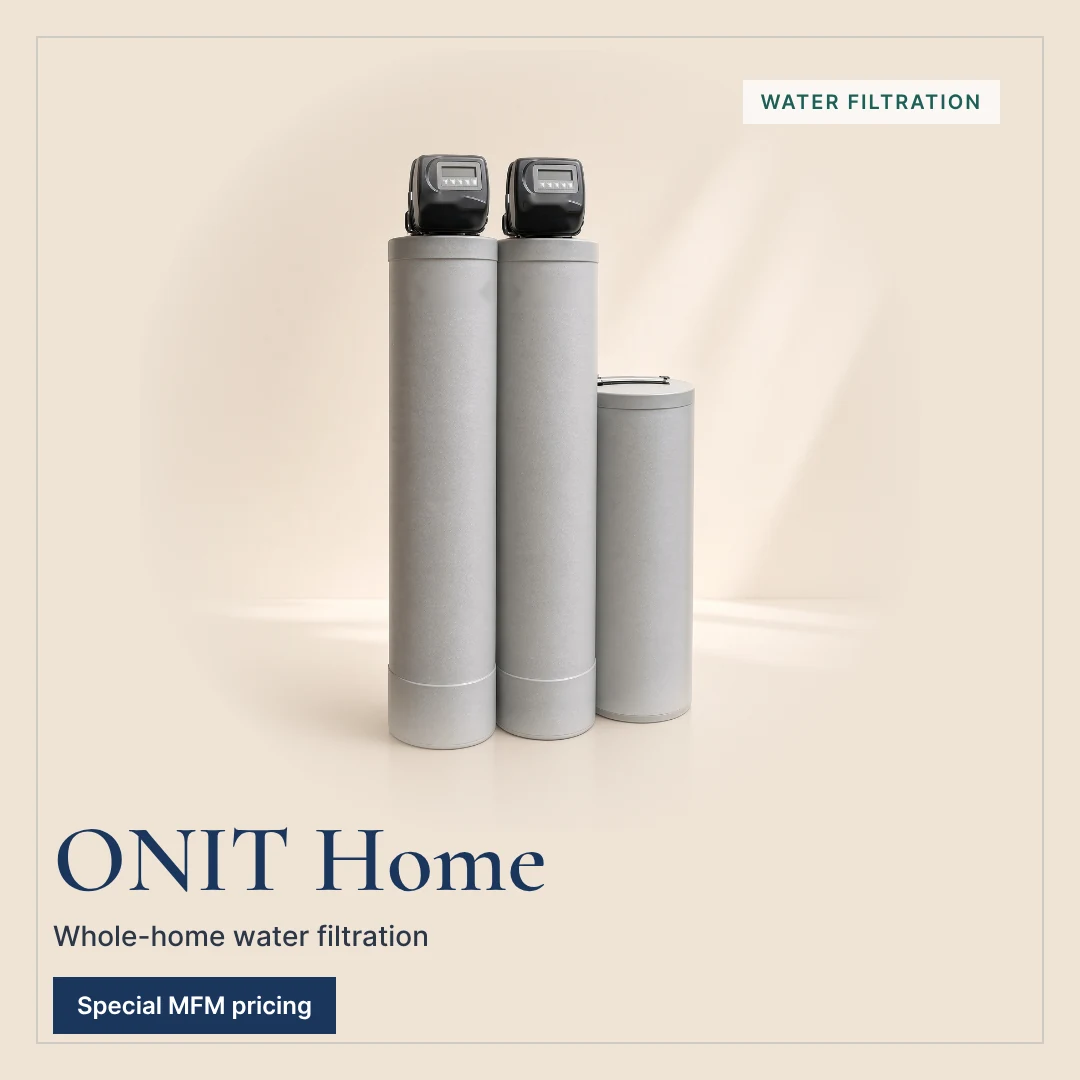
ONIT focuses on Texas water, so this one is for my Texas families. If you're in Texas, see the ONIT Home system in my store and request a referral there for special pricing. This is a partner link, so the affiliate disclosure at the top of this post applies. If you're somewhere else, the steps above still apply. Pull your water report first, then find a local company that will test your water and walk you through the setup.
Why does clean water matter so much during recovery?
If you're healing from mold illness or another chronic condition, water is part of your protocol even when nobody calls it that. Your body needs it for the everyday work of clearing what it doesn't need, and many recovery plans lean on that in one way or another. I've written about what the research actually says about binders, and whatever you think of them, no plan works well in a body that's running dry.
When the water itself carries chemicals, metals, or fluoride, you're asking your body to clear what you just added while it's still working on what was already there. Clean water takes one thing off that list. It also makes it easier to drink enough, because good-tasting water is water you'll reach for. That sounds small until you've tried to get a kid, or yourself, to drink enough of something that tastes like a swimming pool.
I also want to be clear about what I'm not saying. Clean water doesn't treat mold illness, and no filter can fix a house that's still growing mold. If you're still breathing it, that comes first, and the mold assessment is where I send people who aren't sure whether their symptoms fit. Recovery is about lowering the total load wherever you can. You can't control every exposure in the world, but you can control what comes out of your own tap. And if you need a reminder that recovery is real, I've written about whether your body can heal from mold, and the short answer is yes.
One step at a time
Healing a home and a body doesn't happen in a weekend. It happens through small, steady decisions that add up. Clean water is one of the most practical ones you can make, and it supports everything else you're already doing, from the air you've cleaned up to the food you've changed.
So here's the order I'd follow. Pull your water report, or test your well. Decide what matters most to you, whether that's chlorine, lead, PFAS, fluoride, or all of it. Then build in two steps, the softener first and RO with a remineralizer second, and don't let anyone talk you into skipping the first one to save money on the second. Once it's in, test the water from your kitchen tap again, because the CDC is clear that taste and smell can't tell you whether water is safe.
If you'd like help figuring out where to start, reach out. I'm always happy to point you toward people I trust, and if you want someone walking through the whole picture with you, that's what my recovery programs are for.
This post is for education only and isn't medical advice. Talk with your provider about what's right for your own health and recovery.
Rooting for you, Aubree
Sources
- US Environmental Protection Agency, National Primary Drinking Water Regulations: https://www.epa.gov/ground-water-and-drinking-water/national-primary-drinking-water-regulations
- US Environmental Protection Agency, Volatile Organic Compounds' Impact on Indoor Air Quality: https://www.epa.gov/indoor-air-quality-iaq/volatile-organic-compounds-impact-indoor-air-quality
- US Environmental Protection Agency, PFAS Explained: https://www.epa.gov/pfas/pfas-explained
- National Institute of Environmental Health Sciences, Flame Retardants: https://www.niehs.nih.gov/health/topics/agents/flame_retardants
- US Environmental Protection Agency, Chloramines in Drinking Water: https://www.epa.gov/dwreginfo/chloramines-drinking-water
- US Environmental Protection Agency, Stage 1 and Stage 2 Disinfectants and Disinfection Byproducts Rules: https://www.epa.gov/dwreginfo/stage-1-and-stage-2-disinfectants-and-disinfection-byproducts-rules
- US Environmental Protection Agency, Basic Information about Lead in Drinking Water: https://www.epa.gov/ground-water-and-drinking-water/basic-information-about-lead-drinking-water
- Centers for Disease Control and Prevention, About Community Water Fluoridation: https://www.cdc.gov/fluoridation/about/index.html
- National Toxicology Program, Fluoride State of the Science Monograph (2024): https://ntp.niehs.nih.gov/whatwestudy/assessments/noncancer/completed/fluoride
- JAMA Pediatrics, Taylor et al. 2025, Fluoride Exposure and Children's IQ Scores, Systematic Review and Meta-Analysis: https://jamanetwork.com/journals/jamapediatrics/fullarticle/2828425
- Centers for Disease Control and Prevention, Choosing Home Water Filters: https://www.cdc.gov/drinking-water/prevention/about-choosing-home-water-filters.html
- American Dental Association, Fluoridation Facts (2025), Question 16: https://ebooks.ada.org/fluoridationfacts/45
- US Environmental Protection Agency, Consumer Confidence Report Information for Consumers: https://www.epa.gov/ccr/ccr-information-consumers
- US Environmental Protection Agency, Private Drinking Water Wells: https://www.epa.gov/privatewells
- US Geological Survey, Hardness of Water: https://www.usgs.gov/special-topics/water-science-school/science/hardness-water
- US Environmental Protection Agency, Water Health Series on Filtration Facts: https://www.epa.gov/sites/default/files/2015-11/documents/2005_11_17_faq_fs_healthseries_filtration.pdf
- US Environmental Protection Agency, Reducing PFAS in Drinking Water with Treatment Technologies: https://www.epa.gov/sciencematters/reducing-pfas-drinking-water-treatment-technologies
- Centers for Disease Control and Prevention, About Home Water Treatment Systems: https://www.cdc.gov/drinking-water/about/about-home-water-treatment-systems.html
- World Health Organization, Nutrients in Drinking Water: https://www.who.int/publications/i/item/9241593989
- US District Court, Northern District of California, Food & Water Watch v. EPA, Findings of Fact and Conclusions of Law (Sept. 24, 2024): https://storage.courtlistener.com/recap/gov.uscourts.cand.310380/gov.uscourts.cand.310380.445.0.pdf
- Luke J., Fluoride Deposition in the Aged Human Pineal Gland, Caries Research 2001 (PubMed): https://pubmed.ncbi.nlm.nih.gov/11275672/
- National Research Council (2006), Fluoride in Drinking Water, Chapter 8: Effects on the Endocrine System: https://www.nationalacademies.org/read/11571/chapter/10
- National Research Council (2006), Fluoride in Drinking Water, Summary: https://www.nationalacademies.org/read/11571/chapter/2
- CDC National Center for Health Statistics, Prevalence and Severity of Dental Fluorosis in the United States, 1999-2004: https://www.cdc.gov/nchs/products/databriefs/db53.htm
- CDC, Recommendations for Using Fluoride to Prevent and Control Dental Caries in the United States (MMWR 2001): https://www.cdc.gov/mmwr/preview/mmwrhtml/rr5014a1.htm
- Vinceti S.R. et al., Water Fluoridation Between Public Health and Public Law, Annali di Igiene 2024: https://www.mattioli1885journals.com/index.php/annali-igiene/article/download/17510/12584/137225
- NBC News, Florida Becomes Second State to Ban Fluoride in Public Water (May 2025): https://www.nbcnews.com/news/us-news/florida-becomes-second-state-ban-fluoride-public-water-rcna205127
- Florida Senate, SB 700 (2025), Chapter 2025-22: https://www.flsenate.gov/Session/Bill/2025/700
- CDC, Community Water Fluoridation Frequently Asked Questions: https://www.cdc.gov/fluoridation/faq/index.html
Frequently Asked Questions
Water softener vs reverse osmosis: which one do I actually need?
They do different jobs, so most families who go all in end up with both. A softener treats the whole house for hardness, which protects your plumbing and appliances and makes the RO membrane's job easier, but the American Dental Association notes that softening doesn't change fluoride levels. Reverse osmosis treats the water you drink and cook with, and it's the step that takes out fluoride, PFAS, and many other dissolved contaminants. If you can only do one right now, start with the water you swallow.
Do pitcher filters or fridge filters remove fluoride?
Most don't. The CDC explains that the carbon filters in pitchers and refrigerators are mainly designed to improve taste and odor. They can make water taste better, but they generally leave fluoride where it is, and reverse osmosis is the type of system that may reduce it.
Is well water safer than city water?
Not automatically. City water has to meet EPA standards and comes with an annual report, while private wells aren't covered by federal drinking water rules. If you're on a well, testing is your job, and things like nitrates, arsenic, and bacteria won't announce themselves.
What are the first signs my water might have a problem?
Spots on glassware, scale on fixtures, dry skin and hair after showers, and a pool smell when a glass sits out overnight are the clues I'd pay attention to. None of them prove anything on their own, and plenty of problems have no clue at all. Treat them as a nudge to pull your water report or run a test, not as a diagnosis.
How do I find out what's actually in my water?
Start with your water system's annual Consumer Confidence Report, which lists what was found and how it compares to legal limits. If you're on a well, send a sample to a certified lab. If you want to know what's coming out of your own tap rather than what left the plant, an independent test from your kitchen sink is the way to see it.
Is fluoride in tap water safe?
I don't think it belongs in your drinking water. A 2024 National Toxicology Program review linked fluoride above 1.5 mg/L to lower IQ in children, and a federal court ruled in 2024 that fluoridation at 0.7 mg/L, the level the US considers optimal, poses an unreasonable risk of reduced IQ in children. The CDC's own recommendations say fluoride does most of its work topically, on teeth that have already come in, which is why I'd rather get it from toothpaste than from every glass. Reverse osmosis is a dependable way to take it out at home.
Is fluoride banned in other countries?
Most of the European Union simply doesn't add it. A 2024 review found water fluoridation almost entirely absent in the EU outside Ireland and parts of Spain, and it notes there's no EU law forcing or banning it, so each country decides. In the US, Utah and Florida passed state laws in 2025 banning fluoride from public water.
Can I use tap water to mix baby formula?
If your tap water is fluoridated, the CDC says formula mixed with it may raise your baby's chance of mild dental fluorosis when formula is the main food. It suggests using low-fluoride bottled water labeled deionized, purified, demineralized, or distilled some of the time. Ready-to-feed formula contains little fluoride.
Is the chlorine in my tap water dangerous?
Chlorine and chloramine are added on purpose to kill germs, and that protection matters. The EPA regulates both the disinfectants and the byproducts they form. Many families still choose to filter them out for taste and to lower the total number of things their body has to deal with, and that's a reasonable choice to make.
Does reverse osmosis take out the good minerals too?
Yes. The CDC notes RO may reduce calcium and magnesium along with the contaminants, which is why a remineralizer after the RO is worth adding. It puts some minerals back and makes the water taste fuller, so people actually drink it.
How often do I need to change the filters?
Follow the schedule that came with your system, because it varies by system, by how much water your family uses, and by what's in your water to begin with. Put the dates on your calendar the day you install it. A filter nobody changes eventually stops doing its job.
Should I fix my water before I deal with mold in my house?
No. If mold is still growing in your home, that comes first, because no filter can offset what you're breathing every day. Water is one piece of lowering your total load, and it's a good one, but it isn't the foundation of a house that's still wet. If you're not sure whether your symptoms fit mold, start with the mold assessment on this site.

Aubree Felderhoff
Board Certified Holistic Health Practitioner | Mold Recovery Concierge | Certified Primal Health Coach | Master Personal Trainer
Aubree spent 12 years and more than $250,000 searching for answers to a mystery chronic illness that 30-plus doctors couldn't solve. The first culprit was a mycotoxin-overloaded home that triggered a cascade of symptoms nobody could trace back to the source. After finally identifying the connection, remediating, and rebuilding her health, she faced a second exposure years later when water damage in her next home brought the symptoms flooding back.
That second experience is what shaped everything. She found a physician who understood antifungal treatment, completed neuroplasticity training, and fully recovered. Having navigated mold illness twice, from two different sources, she understands both how it starts and how it ends.
Aubree is a Board Certified Holistic Health Practitioner through the American Association of Drugless Practitioners (AADP), a Certified Primal Health Coach, NASM Certified Trainer, and Cooper Clinic Certified. Before mold illness defined her life, she spent 14 years in elite fitness as a national champion collegiate gymnast. She brings that same discipline and evidence-based approach to mold recovery, helping families get clear answers faster, without the decade of wrong turns she endured.
The newsletter
A little hope in your inbox
One email a week from me, with what actually helps families get better. No spam, unsubscribe anytime.
Keep learning with mold illness guides
Start-here pages on symptoms, testing, CIRS, remediation, and hiring an inspector. Free tools and program paths are linked from each guide.
- Mold Illness Symptoms GuideHow mold-related symptoms show up across body systems, why they get misdiagnosed, and when a pattern points to exposure.
- How to Test for Mold IllnessWhy blood testing comes first, where urine mycotoxin and ERMI fall short, and how to order body vs home testing without wasting money.
Need personalized guidance?
Start with free guides and the symptom assessment, or talk with Aubree about the right program path.