
Why the ERMI Test Is Almost Always a Waste of Time and Money
Quick Answer
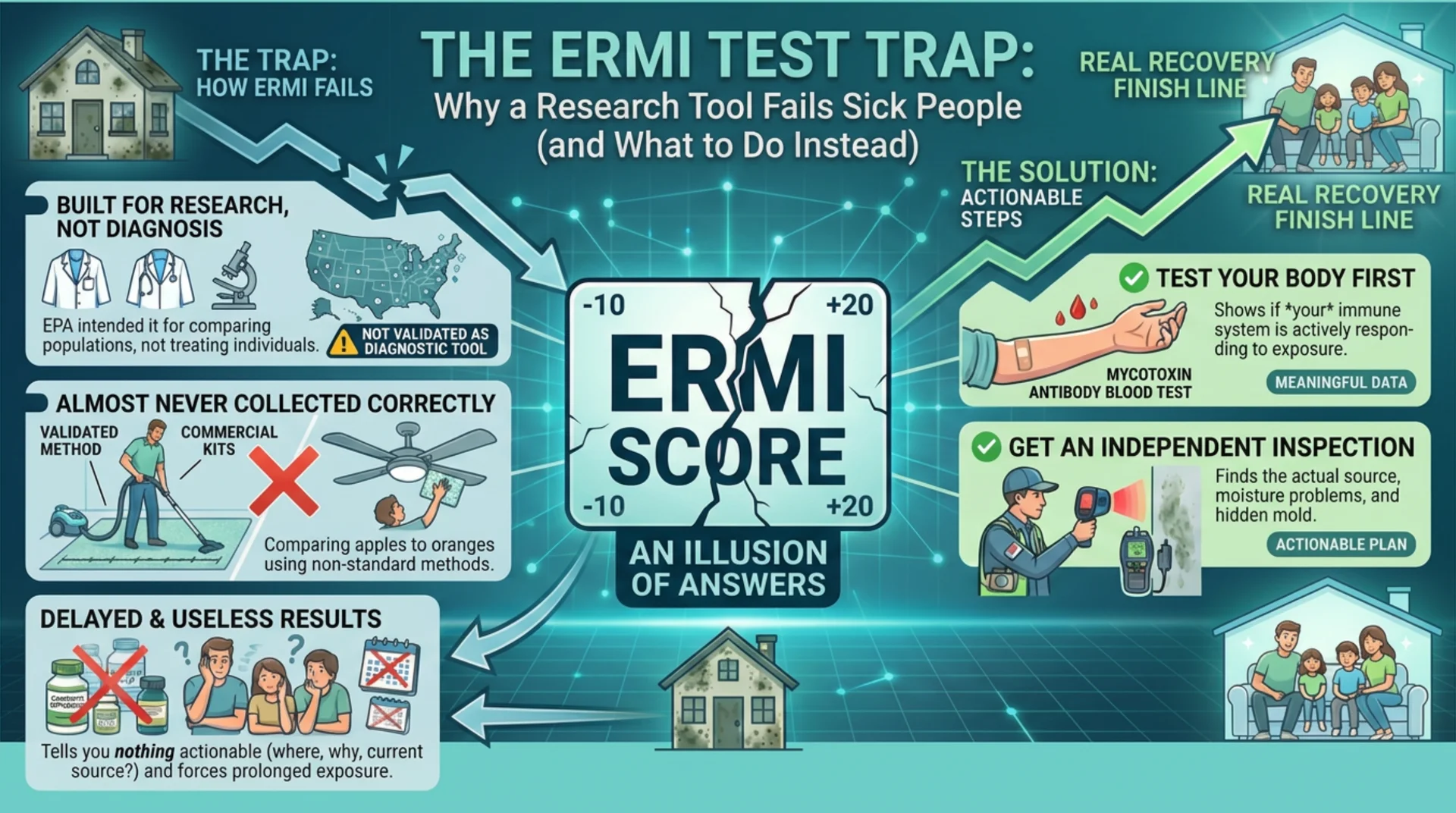
The ERMI test was built for population research, not for sick people looking for answers. It almost never tells you what you need to know about mold.
If you're sick and trying to figure out if mold is the cause, the ERMI test is one of the most-recommended tools in the mold world and one of the least useful for actually getting you answers. The test wasn't built for you. It was built for population research, it's almost never collected the way it was validated, and even when it is, the result doesn't tell you what you need to know.
I've taken ERMI tests in the past. More than one. I took them because I was sick, scared, and being told by practitioners that I needed the score to know what we were dealing with. The scores came back. Nothing changed. I was no closer to understanding why I was sick, where the mold was, or what to do next. What the scores did was justify another round of expensive supplements I didn't need.
So I want to walk you through exactly why this test fails the people who need help most, and what to do instead.
What is the ERMI test, and what was it actually built for?
The Environmental Relative Moldiness Index, or ERMI, was developed by the United States Environmental Protection Agency in the early 2000s. A research scientist named Dr. Stephen Vesper led the work, and the test was created for a very specific purpose: to give researchers a standardized way to compare mold contamination levels across large numbers of homes.
The original work was done as part of the American Healthy Homes Survey, a nationally representative study of US housing stock. Dust samples were collected from over 1,000 homes using a standardized vacuum method, and the lab measured the DNA of 36 mold species using a technique called quantitative PCR. Those measurements were used to build a reference scale, which is the ERMI scoring system you see today.
The key word in all of that is research. The ERMI was never designed to diagnose mold illness, identify where mold is in your home, or guide treatment decisions for an individual person. The EPA has stated this directly. From their own published position: ERMI is a research tool and is not recommended for use except as a research tool.
That hasn't stopped a thriving industry from selling ERMI kits to sick people for around 200 to 350 dollars per test, often as the first step in a long, expensive protocol. The test is being used in ways its creator explicitly cautioned against. That's not a small detail. That's the whole story.
What an ERMI score actually means in plain English
When you order an ERMI kit, you receive a dust collection device, instructions, and a return envelope. You collect a dust sample from your home, mail it to the lab, and a few weeks later you get back a number.
That number can range from roughly negative 10 to positive 20 or higher. The math is straightforward: the lab measures the concentration of 26 mold species associated with water-damaged buildings (called Group 1) and the concentration of 10 mold species commonly found outdoors (called Group 2). They subtract Group 2 from Group 1, and that's your score.
A higher number means more water-damage-associated mold in your dust relative to outdoor mold. A lower number means less. The test then compares your score against the EPA's national database, and you're told whether your home falls into the low, medium, or high moldiness category compared to other US homes.
Here's what most people aren't told: the score is a relative ranking, not an absolute measurement. It tells you how your dust compares to a national average of homes built decades ago. It does not tell you whether your home has a current mold problem, where any mold is located, whether the mold detected is actually exposing you, or whether your exposure is what's making you sick.
That gap, between what the test measures and what sick people need to know, is the foundation of everything that follows.
Problem 1: Even when the test is done perfectly, the result doesn't tell you what you need to know
Let's say you collect the sample perfectly. You follow every instruction. The lab processes it correctly. The score comes back high.
What did you just learn?
You learned that, compared to the EPA's reference database of homes, your dust contains a higher-than-average concentration of DNA from mold species associated with water damage. That's it. That's the entire output of the test.
You did not learn whether the mold is currently growing in your home or whether it's old dust from a leak ten years ago that was already remediated. You did not learn where the mold is. You did not learn what building material is affected. You did not learn whether your symptoms are connected to that mold or to something else entirely, like mold exposure at work, in your car, at a relative's house, or in a previous home where you used to live.
The ERMI score gives you a number. It does not give you a cause. It does not give you a location. It does not give you a plan.
Now flip it. Say your score comes back low. Does that mean your home is safe? Not even close. ERMI dust samples are typically collected from one or two rooms, usually the living room and a bedroom. Mold growing inside a wall cavity in another room, behind a vanity in a bathroom, or underneath HVAC ductwork can be devastatingly present and not show up in your dust at all. The test misses what it can't see, and what it can't see is most hidden mold.
This is the conceptual flaw nobody wants to talk about. The test was built to compare houses against each other at a population level. It was never built to answer the question a sick person actually has, which is: is there mold in my home that's making me sick, and where is it.
Problem 2: Almost nobody is doing the test the way it was validated
Here's where it gets worse.
The ERMI scoring scale was built from a very specific dust collection method. Researchers used a special vacuum nozzle to vacuum a precisely measured area of carpet, 2 square meters each, in the living room and the bedroom. Each area was vacuumed for exactly 5 minutes. The dust was processed in a specific way, and that's the data the entire reference database was built on.
That's the test as Vesper designed it. That's the test the scoring scale is calibrated to.
The test you're being sold is different.
Most ERMI kits today come with a Swiffer cloth, not a vacuum attachment. You're instructed to wipe surfaces around your home, often including the tops of door frames, baseboards, ceiling fans, window sills, and dusty corners. That sample is then run through the same lab process and compared to the same reference database that was built using a vacuum on carpet.
This is not a minor methodological quibble. This is comparing one kind of measurement to a scale built from a completely different kind of measurement. An industrial hygienist named Michael Pinto put it plainly: individuals are collecting samples using one method and comparing the results to a table that was designed for samples collected using a different method.
You might see the figure quoted that the Swiffer method agrees with the vacuum method 96 percent of the time. That number gets thrown around to make the Swiffer method sound nearly identical. It isn't.
The 96 percent figure comes from a 2021 study by Vesper himself. What that study actually measured was whether the two methods agreed on placing a home into the highest ERMI quartile. In other words, the two methods agreed 96 percent of the time on a yes-or-no question at the most extreme end of the scoring scale. The study did not show that the two methods produce the same numerical score. They don't. The same study found that Swiffer samples tend to produce higher ERMI values than vacuum samples taken from the same home. Different test. Different result. Same scoring scale being applied as if they were interchangeable.
And Vesper's own conclusion in that paper is worth reading directly. He wrote that the electrostatic cloth method, which is the Swiffer-style method, is not a standardized method of dust collection and is not a replacement for the standard vacuum sampling method. Those are the words of the man who built the test.
So when you pay 250 dollars for a Swiffer kit and wipe your ceiling fans and window sills, you are not taking the ERMI test. You are taking an unstandardized approximation of it, comparing your result to a scale that was built from a different method, and being told the number means something specific. It doesn't.
Problem 3: Even if you insist on doing it right, you've just put your life on hold for a month or more
Let's say you do your homework. You read the studies. You insist on the validated vacuum method. You order a proper kit with a vacuum cassette and you measure out your 2 square meters of carpet. You're going to do this right.
Now read the protocol.
To collect a valid sample, the area you're sampling cannot be cleaned for a period of time before collection. Most labs require at least 2 weeks. Some require 4 to 6 weeks. The reasoning makes sense in research terms: the test depends on accumulated dust, and if you've vacuumed last week, there isn't enough dust to analyze.
Now think about who's buying this test. Sick people. Often mothers with young children. Often families who suspect mold is making them ill. What are these people doing in their homes right now? They're cleaning. Constantly. They're vacuuming with HEPA filters, wiping surfaces, washing fabrics, running air purifiers, trying everything they can to reduce their exposure while they figure out what's happening.
To take the test properly, they have to stop. For 4 to 6 weeks. They have to let dust accumulate in the very environment that may be making them sick, on the same floor where their children play.
If they clean during that window, the test produces what one lab describes as unreliable or artificially low results. If they don't clean, they're choosing prolonged exposure to test for the thing they're trying to escape from.
It gets worse for anyone trying to use the ERMI after remediation. Carpets in a water-damaged home are typically discarded as part of remediation, which is the right call. But it also means the surface the test was validated on is gone. The published guidance on how to properly test a remediated home with new carpet, or with hard floors, is, in the words of one of the protocol's most prominent advocates, sketchy at best.
So even when you do everything correctly, you've delayed any actual decision about your home by over a month. You've sat in dust. You've stopped cleaning. And the test result, when it finally comes, gives you the same limited information we covered in Problem 1.
Problem 4: And at the end of it all, you still need a qualified inspector
This is the part of the story that should end the conversation.
Let's say you've done everything. You used the validated method. You let the dust accumulate. You paid for the test. The score came back high.
What now?
You don't know where the mold is. You don't know what's affected. You don't know whether the source is active or historical. You don't know whether the moisture problem that caused the mold is still happening. You don't know what needs to be removed, repaired, or replaced.
To find any of that out, you need a qualified, independent mold inspector to come into your home, do a moisture assessment, identify visible damage, find hidden sources, and tell you what needs to be done.
The ERMI test cannot do any of that. It was never going to.
So the test didn't replace the step that actually finds your problem. It delayed it. By 4 to 6 weeks of dust accumulation, plus another 1 to 2 weeks of lab turnaround, plus however long it took you to interpret the result and decide what to do next.
If the first step you take is an inspector, the inspector tells you where the mold is, what materials are affected, and what needs to happen. If the first step you take is an ERMI, the test tells you nothing actionable, and then you still need the inspector. The only difference is the time, money, and exposure you've added to the process.
What the EPA and the scientist who developed ERMI actually say
I've referenced this throughout, but it's worth pulling together in one place.
The EPA's own position is that ERMI is a research tool and is not recommended for use as a diagnostic. They've said this in writing. The agency has further stated that deviating from the original sampling protocol, which is exactly what most consumer kits do, produces results of questionable value.
Dr. Vesper, in his published work, has been clear that the test was designed for population-level research, that the Swiffer method is not a replacement for the validated vacuum method, and that the test's purpose is to compare homes at scale, not to diagnose individuals.
Another EPA scientist, Dr. Kevin Oshima, has been even more direct in published comment: because the approach has not been validated through a multi-lab study, the EPA cannot comment on the accuracy of information obtained from anyone using ERMI commercially. Inspection for water damage and mold, he wrote, remains the key to current EPA mold-assessment guidance.
When the agency that developed a test, the scientist who built it, and a co-scientist who works alongside him all say the test isn't a diagnostic and shouldn't be used the way it's being sold, that should be the end of the discussion. It isn't, because the test makes money.
Why ERMI keeps getting recommended anyway
If the test isn't validated for individual use, doesn't tell you where the mold is, can't be done correctly by most of the people buying it, and still requires an inspector at the end, why is it still everywhere?
Because there's an industry built around selling it.
Mold coaches, certain practitioners, and some lab partners use ERMI scores as the entry point into long, expensive treatment programs. A high ERMI score becomes the justification for months of supplements, binders, nasal sprays, and protocols that often cost thousands of dollars. The score gives the recommendation an air of objectivity. The number feels scientific. The supplement plan that follows feels prescribed.
I've been on the receiving end of this. I ran ERMI tests because practitioners I trusted told me I needed them. The scores came back, and the response was always the same: another supplement protocol, another set of products to order, another monthly cost. Nothing in those protocols touched the actual source of my exposure. The exposure was in my home, and finding it required an inspector, not a dust score.
I'm not saying every practitioner who recommends ERMI is acting in bad faith. Many believe in the test because they were trained to. But the financial incentive is real, and the test's limitations are well-documented in the scientific literature. When recommendation patterns persist despite the evidence, it's worth asking what the recommendation is actually accomplishing.
What about HERTSMI-2? Same problems, smaller list
HERTSMI-2 is the cousin test that often shows up in the same conversation. It uses the same general approach as ERMI but tracks only 5 mold species considered the most relevant to chronic inflammatory response. The scoring is different, and the threshold for whether a home is considered safe to re-enter is more aggressive.
Everything I've said about ERMI applies to HERTSMI-2. Same collection problems. Same dust accumulation requirements. Same conceptual flaw of not telling you where the mold is. Same need for an inspector at the end. The shorter species list doesn't fix any of the underlying issues.
If anything, HERTSMI-2 is more concerning because the threshold values are used to make significant decisions, like whether a remediated home is safe for a sensitive person to return to. Those decisions deserve better data than a dust sample collected with a method the test wasn't validated against.
What actually tells you something useful when you suspect mold
If you suspect mold is making you sick, the two pieces of information you actually need are: what's happening inside your body, and what's happening inside your home. Neither of those questions is well-answered by ERMI.
For your body, a blood test that measures mycotoxin antibodies can tell you whether your immune system is currently responding to mold exposure. This is meaningful, actionable information about you specifically, not a comparison to a database. I wrote a full post on why blood testing should come before environmental testing, and I'd recommend reading that next.
For your home, you need a qualified, independent mold inspector. The key word is independent. You want someone who doesn't also sell you remediation, because the incentive structure matters. A good inspector will do a moisture assessment, look for visible damage, use thermal imaging and moisture meters to find hidden problems, and tell you what needs to happen. If air sampling is part of the inspection, it should be done by a professional in real time during the inspection, not handed to you in a kit.
Those two steps together, a blood test for your body and an independent inspection of your home, give you actionable, individual-level information. The ERMI gives you a number that requires interpretation and still leaves you needing the inspector.
If you're still trying to work out whether your symptoms might be mold-related at all, my post on why standard tests come back normal even when you're sick covers the testing trap in more detail.
What to do if you already paid for an ERMI
If you've already taken an ERMI test, you haven't done anything wrong. Many smart, careful, well-researched people take these tests because they're recommended by people they trust. Don't beat yourself up.
A few practical thoughts on what to do with the result you have:
- Don't act on the score alone. A high score doesn't tell you where to spend your money, and a low score doesn't mean you're safe. Either way, the next step is an inspector, not a supplement protocol.
- Don't let it spiral you into months of expensive treatment. If someone is using your ERMI score as the basis for a long, costly protocol of supplements or binders, ask them how that protocol addresses the actual source of your exposure. If the answer involves dosing your body to handle ongoing exposure rather than finding and removing the source, that's a red flag.
- Use it as one small data point, not the answer. The score, with all its limitations, can occasionally provide a directional hint. It's not nothing. It's just nowhere near enough to base decisions on.
Stop testing your dust. Start with an assessment.
The smartest first step when you suspect mold isn't a 300-dollar test. It's getting clear on what you're actually dealing with.
If you've been wondering whether your symptoms might be mold-related, whether your home might be the source, or whether the path you're currently on is the right one, take the free mold assessment. It walks you through the questions that actually matter, points you toward the next step that makes sense for your specific situation, and doesn't require you to stop cleaning your house for six weeks.
The ERMI test was built for researchers comparing homes at a population level. You're not a research subject. You're a sick person trying to get well, or a parent trying to protect a sick child. You deserve tools that answer your actual questions, not a number that gives you the illusion of an answer while delaying the work that has to happen anyway.
If you want personalized guidance on what to test, when to test it, and how to read what you've already paid for, the Mold Free Mom program is built for exactly that.
Sources
- Vesper, S., et al. "Development of an Environmental Relative Moldiness Index for U.S. Homes." Journal of Occupational and Environmental Medicine, 2007. PubMed.
- Vesper, S., et al. "Comparison of ERMI results for dust collected from homes by electrostatic cloth and by the standard vacuum method." International Journal of Environmental Health Research, 2021. PubMed Central.
- U.S. Environmental Protection Agency. Position statement on the use of the Environmental Relative Moldiness Index. EPA.gov.
- Cai, G.H., et al. "Comparison of indoor air sampling and dust collection methods for fungal exposure assessment using quantitative PCR." Environmental Science: Processes and Impacts, 2018. PubMed Central.
- American Industrial Hygiene Association. "Recognition, Evaluation, and Control of Indoor Mold." AIHA Position on Mold Sampling Methodology. AIHA.org.
- Centers for Disease Control and Prevention. "Basic Facts about Mold and Dampness." CDC.gov.
Frequently Asked Questions
What is the ERMI test?
The ERMI, or Environmental Relative Moldiness Index, is a dust-based mold test developed by the U.S. Environmental Protection Agency. It measures the DNA of 36 specific mold species in a dust sample and compares the result to a reference database of US homes to produce a relative moldiness score.
Is the ERMI test accurate?
The ERMI test produces a numerical score, but the accuracy of that score depends heavily on whether the sample was collected using the validated method, which is a specific 5-minute vacuum protocol on carpet. Most consumer kits today use a Swiffer-style cloth, which the test's own developer has stated is not a replacement for the validated method. Even when collected correctly, the test only tells you how your home compares to a national database, not whether mold is currently making you sick or where it is.
Did the EPA create the ERMI test?
Yes. The ERMI was developed by EPA scientist Dr. Stephen Vesper and colleagues in the early 2000s, primarily for research use as part of the American Healthy Homes Survey. The EPA has stated that it is a research tool and is not recommended for individual diagnostic use.
Can an ERMI test diagnose mold illness?
No. The ERMI test cannot diagnose mold illness. It measures mold DNA in settled dust and provides a relative ranking against a database of US homes. It does not measure your body's response to mold, does not identify where mold is growing in your home, and does not establish a cause-and-effect relationship between any exposure and your symptoms.
How much does an ERMI test cost?
Consumer ERMI kits typically cost between 200 and 350 US dollars depending on the lab and whether the kit includes additional analyses like HERTSMI-2 or expanded species testing.
What is the difference between ERMI and HERTSMI-2?
HERTSMI-2 uses the same general dust-based methodology as ERMI but tracks only 5 mold species considered most relevant to chronic inflammatory response. The scoring system is different and the thresholds are used to make more aggressive decisions about home safety. The same collection and validation problems that affect ERMI also affect HERTSMI-2.
Why do mold coaches recommend ERMI testing?
ERMI testing is often recommended as an entry point into longer, more expensive treatment programs. A high score can be used to justify months of supplements, binders, and protocols. The financial incentive to recommend the test is real, even when the test's limitations are well-documented in the scientific literature.
Should I get an ERMI test before a mold inspection?
No. If you suspect mold is making you sick, the more useful first steps are a blood test that measures your body's response to mold and an independent inspection of your home by a qualified mold inspector. The ERMI does not replace inspection and typically delays it by 4 to 6 weeks of required dust accumulation plus lab turnaround time.
What should I do if my ERMI score is high?
Don't act on the score alone. A high score doesn't tell you where the mold is or what needs to be done. The next step is a qualified, independent mold inspector who can identify the actual source. Avoid using the score as the basis for long, expensive supplement protocols that don't address the source of exposure.
How long do I need to avoid cleaning before an ERMI test?
Most labs require that the sampling area not be cleaned for 2 to 6 weeks before collection. This is one of the test's biggest practical problems, because the people most likely to buy it are sick people trying to reduce mold exposure by cleaning. Following the protocol means prolonged exposure to the very environment that may be causing illness.
Is the ERMI test useful if I follow the protocol exactly?
Even when collected with the validated vacuum method and the proper dust accumulation period, the ERMI score only tells you how your home compares to a national database. It does not tell you where the mold is, whether the exposure is current, or whether it's the source of your symptoms. You still need a qualified inspector to find the actual problem. The test doesn't replace inspection. It delays it.
What is a better alternative to the ERMI test?
Two steps give you the actionable information ERMI doesn't: a blood test for mycotoxin antibodies to assess your body's response, and an independent inspection of your home by a qualified mold inspector who doesn't also sell remediation. Together, those two steps tell you what's happening inside you and what's happening in your home, which is what you actually need to make decisions.

Aubree Felderhoff
Board Certified Holistic Health Practitioner | Mold Recovery Concierge | Certified Primal Health Coach | Master Personal Trainer
Aubree spent 12 years and more than $250,000 searching for answers to a mystery chronic illness that 30-plus doctors couldn't solve. The first culprit was a mycotoxin-overloaded home that triggered a cascade of symptoms nobody could trace back to the source. After finally identifying the connection, remediating, and rebuilding her health, she faced a second exposure years later when water damage in her next home brought the symptoms flooding back.
That second experience is what shaped everything. She found a physician who understood antifungal treatment, completed neuroplasticity training, and fully recovered. Having navigated mold illness twice, from two different sources, she understands both how it starts and how it ends.
Aubree is a Board Certified Holistic Health Practitioner through the American Association of Drugless Practitioners (AADP), a Certified Primal Health Coach, NASM Certified Trainer, and Cooper Clinic Certified. Before mold illness defined her life, she spent 14 years in elite fitness as a national champion collegiate gymnast. She brings that same discipline and evidence-based approach to mold recovery, helping families get clear answers faster, without the decade of wrong turns she endured.
The newsletter
A little hope in your inbox
One email a week from me, with what actually helps families get better. No spam, unsubscribe anytime.
Recommended Products
Recommended Products may include affiliate links. See our Affiliate Disclosure for details.
Keep learning with mold illness guides
Start-here pages on symptoms, testing, CIRS, remediation, and hiring an inspector. Free tools and program paths are linked from each guide.
- How to Find a Good Mold InspectorQuestions, red flags, moisture-source criteria, and a free hiring checklist so you do not pay for a flashlight walkthrough.
- How to Test for Mold IllnessWhy blood testing comes first, where urine mycotoxin and ERMI fall short, and how to order body vs home testing without wasting money.
- Mold Illness Symptoms GuideHow mold-related symptoms show up across body systems, why they get misdiagnosed, and when a pattern points to exposure.
Need personalized guidance?
Start with free guides and the symptom assessment, or talk with Aubree about the right program path.